How do you grow a fencing business?
Build local visibility for the fence types and customer needs you serve, show real installations, qualify project fit, follow up on estimates and track which sources create booked installs.
Fence demand starts with a property need—privacy, pets, pools, security, boundary changes or appearance—then moves through material choices, site conditions, estimates and scheduling. A useful growth system makes each of those handoffs clearer instead of only chasing more quote requests.
A fence lead is more useful when the business understands project type, material, geography and timing before spending heavily on the estimate.
Build local visibility for the fence types and customer needs you serve, show real installations, qualify project fit, follow up on estimates and track which sources create booked installs.
Local search, referrals, neighborhood proof, reviews and contractor/property relationships can all help. Better estimate follow-up may also recover opportunities already in the pipeline.
Standardize intake, site-visit scheduling, estimate follow-up, review/referral capture and source tracking. Crew, materials and permitting remain operational constraints.
Prioritize the materials and project types the company wants—wood, vinyl, aluminum, chain link, pool, commercial, privacy, etc.—without making thin pages for every product variation.
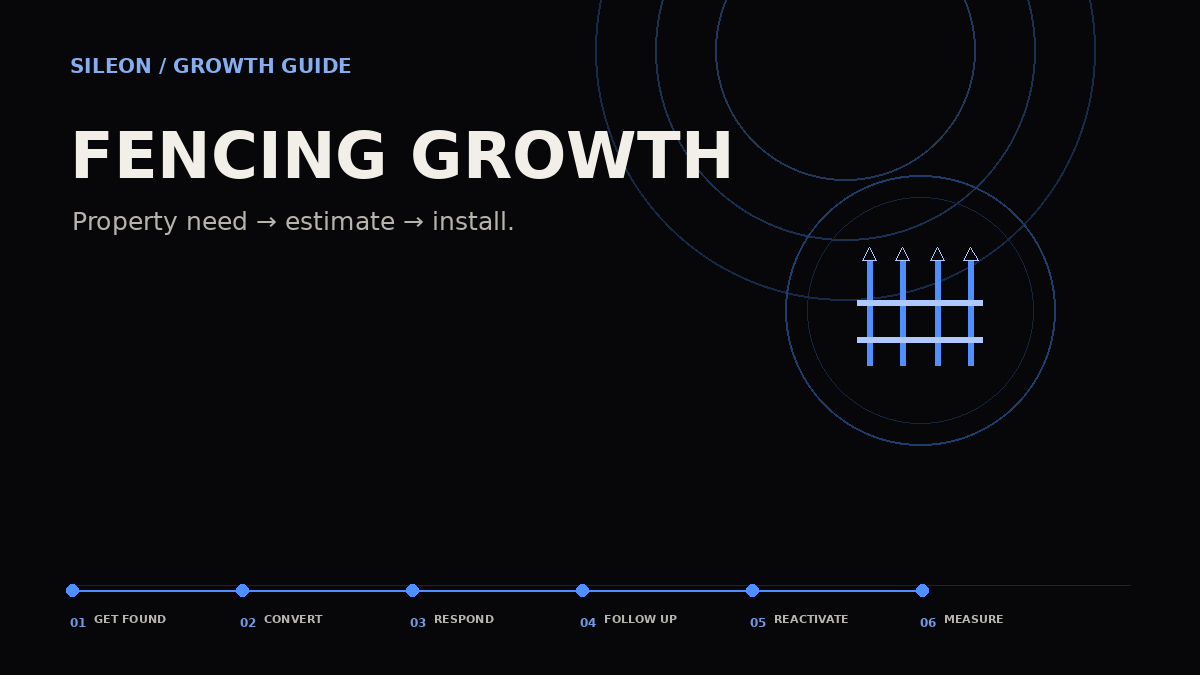
Growth is easier to reason about when the customer journey is broken into observable stages instead of a pile of marketing tactics.
Answer from what you can verify today. “Not sure” is useful: it usually means the measurement layer needs attention before anyone confidently prescribes more marketing.
Can a local homeowner searching for a priority fence project find a relevant page that matches the need?
Can a prospect see fences like the one they are considering and understand how an estimate starts?
Does the first response gather enough information to schedule an appropriate estimate without pretending to resolve property-specific issues remotely?
Can you see every viable fence estimate and what decision is still pending?
After a successful fence install, is there a consistent process to capture feedback and useful project proof?
Can you compare sources by the fence projects they actually become?
Answer all six questions to see which station deserves inspection first.
Fence projects can be highly local and visual, but also constrained by site conditions, materials and local rules. The acquisition path should create clarity without pretending to solve property-specific issues online.
Review reviews, project photos and neighborhood/referral relationships.
Check Reactivate →People often want privacy, pet containment, pool compliance, security or a boundary solution before they know what fence material they prefer. The website can meet that intent while still routing to the right installation expertise.
Connect common customer goals to real fence options without prescribing a property-specific solution before inspection.
Installed fences are visible. Real local/project photography can communicate workmanship and style better than stock catalogs alone.
Property lines, slopes, access, permits or utility considerations can affect the job. Intake should surface context while leaving technical decisions to the onsite process.
Fence customers may search by material or by outcome. A privacy-focused homeowner and a commercial chain-link buyer have different journeys even if both need a “fence contractor.”
The site should organize those intents at a useful level without generating dozens of near-duplicate material-location pages.
Improvement means more qualified local discovery around the fence projects the company wants.
A manufacturer catalog can show products, but it does not prove the company’s installation quality or ability to handle a particular site.
Conversion improves when the page combines material understanding with real completed work and a clear next step.
Improvement means more good-fit visitors request estimates with clearer project expectations.
Fence estimates often require onsite review. The intake does not need to collect every measurement; it needs to confirm the project is plausible and move the prospect toward the right next step.
Avoid giving definitive property-line, permitting or compliance advice from a generic form.
Improvement means legitimate inquiries receive acknowledgement and good-fit site visits are scheduled consistently.
Fence projects can pause around budget, landscaping, pools, pets, property work or seasonal timing. A quiet estimate is not always a hard no.
The follow-up system should make those dependencies visible while respecting the customer’s timing.
Improvement means viable estimates remain visible through a real decision.
Fences are physically visible to neighbors and often tied to other property projects. A good installation can become local proof and create introductions.
Those relationships are valuable when they arise from actual service quality—not from spammy partner outreach.
Improvement means more verified proof, reviews and appropriate referrals come from completed work.
A source can generate lots of price-shopping inquiries while another creates fewer but better-fit installs. The owner needs outcome context to tell the difference.
Measurement should make project mix visible rather than collapsing every request into a lead total.
Improvement means channel decisions can follow booked-install quality and geography.
If quote requests already exist, the highest-value repair may be after discovery rather than another ad campaign.
A diagnosis only matters if it changes what gets done. These are example directions, not a promise that every business needs every service.
Build visibility around meaningful fence project/material categories and real service areas.
Use real installation proof and clearer project paths to improve estimate confidence.
Use your own gross-profit and opportunity numbers. This is scenario math, not an industry benchmark, forecast or Sileon promise.
Use gross profit from the project category you want more of. A small repair, residential privacy fence and commercial installation can differ significantly.
Use gross profit rather than revenue if you can. If you do not know the inputs, that is a measurement problem worth fixing first.
This calculator only compares two owner-provided conversion scenarios.
The metric should match the station. Rankings, traffic or automation activity are not enough by themselves if the business cannot connect them to an acquisition outcome.
Track project/material search visibility and qualified estimate requests.
Track qualified estimate requests from priority fence/material pages.
Track response, qualification and site-visit scheduling.
Track open estimates, follow-ups, decision status and booked installs.
Track proof assets, reviews, referrals and repeat/project-partner sources.
Track source → project/material → estimate → booked install.
More estimates do not help when crews, materials or project scheduling are already stretched. Acquisition should support a reliable installation experience.
Use the first 90 days to define priority fence work, strengthen proof and stop viable estimates from disappearing.
Baseline project/material categories, sources, response, site visits, open estimates and proof.
Sequence, then measureImprove local visibility, installed proof, response or estimate follow-up based on the largest leak.
Sequence, then measureMeasure booked work by source/project type before increasing acquisition spend.
Sequence, then measureThe free growth audit looks at search, project proof, response, estimate follow-up and measurement before recommending more lead volume.