How do you grow a remodeling business?
Be discoverable for the rooms and projects you want, show credible before-and-after proof, make consultation requests easy, qualify fit, follow up on estimates and measure which sources become signed work.
Remodeling demand is highly visual, trust-heavy and usually slower than an emergency service call. Growth depends on being found for the right rooms and project types, proving the work before the consultation, handling inquiries well, following up on estimates and knowing which sources create projects worth taking.
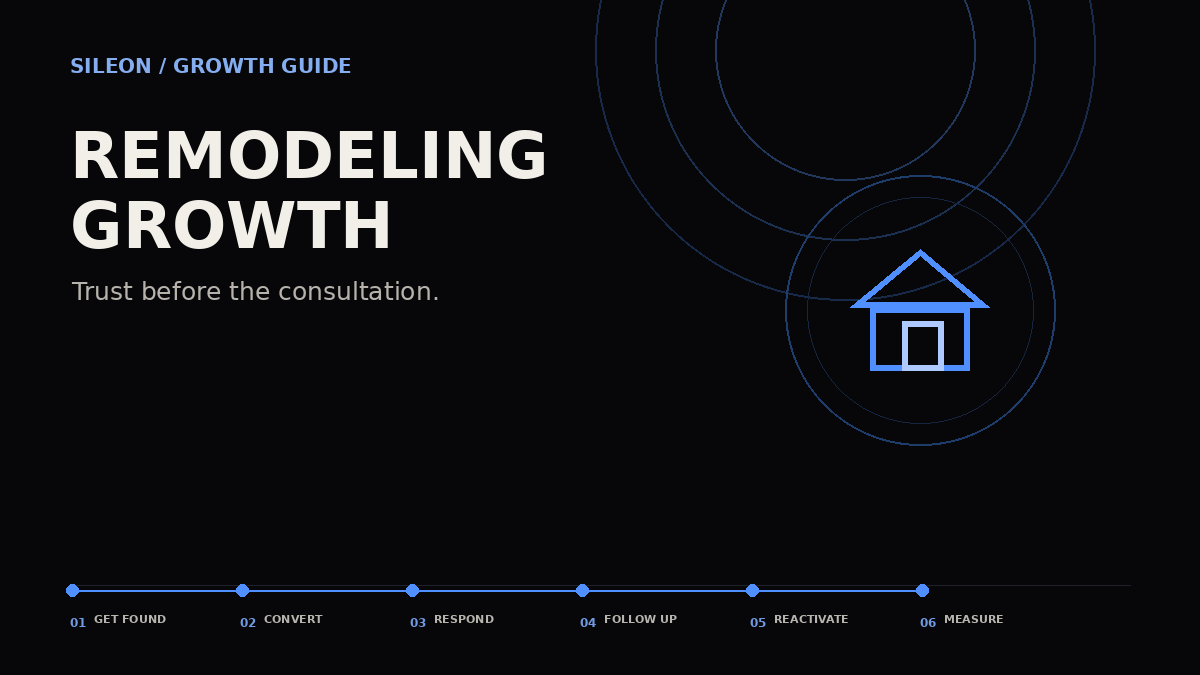
Remodeling marketing works better when search intent, visual proof, project fit and the post-estimate process reinforce each other.
Be discoverable for the rooms and projects you want, show credible before-and-after proof, make consultation requests easy, qualify fit, follow up on estimates and measure which sources become signed work.
Local search, referrals and project-specific content can create demand, but a stronger website and estimate process may recover more value from the demand you already have.
Standardize intake, consultation ownership, estimate follow-up and source tracking so the owner is not manually carrying every sales step. Capacity and project management still have to scale too.
Start with the project types and neighborhoods you actually want. A focused kitchen, bath or whole-home growth path is usually easier to measure than generic “home improvement” visibility.
Growth is easier to reason about when the customer journey is broken into observable stages instead of a pile of marketing tactics.
Answer from what you can verify today. “Not sure” is useful: it usually means the measurement layer needs attention before anyone confidently prescribes more marketing.
Can someone searching for your priority remodeling service and area land on a page that clearly matches that project?
Can a homeowner see enough relevant work and process detail to feel comfortable requesting a consultation?
Does a legitimate remodeling inquiry get acknowledged and moved toward a clear consultation decision even when the owner is on a jobsite?
Can you see every viable remodel that is still deciding, along with the next promised follow-up?
Do satisfied remodeling clients have a natural way to leave a review, refer someone or return for another project later?
Can you tell whether search, referrals, social or another source creates the remodeling projects you actually want?
Answer all six questions to see which station deserves inspection first.
A remodeler can lose a good project before the consultation, during slow response, or weeks after an estimate. The six stations make those losses visible instead of treating “marketing” as one bucket.
Separate kitchen, bath, addition and whole-home visibility instead of hiding everything under one generic services page.
Check Get Found →Inspect galleries, case context, reviews, process explanation and mobile CTA clarity.
Check Convert →Homeowners often research for a while before committing. The strongest acquisition system makes it easy to imagine the outcome, verify the contractor and understand the next step without manufacturing urgency.
A gallery should do more than look attractive. Label the type of project, the problem solved and the kind of work the company wants more of.
The first conversation should confirm scope, location, rough timing and fit before the business spends deeply on design or estimating.
A homeowner may pause for budget, financing or timing. Respectful follow-up should keep viable projects visible without turning into pressure.
Remodeling searches tend to carry different intent depending on the room, project scale and stage of planning. A homeowner researching a kitchen remodel may not respond to the same page as someone considering a whole-home renovation.
The discovery layer should make the company relevant for the projects it is actually equipped and interested in selling.
Improvement means qualified discovery grows around priority remodeling services and markets.
Remodeling is visual, but a beautiful portfolio alone does not answer every buying question. Homeowners also need to understand what the company does, whether it works in their area and what will happen after they reach out.
The best conversion work combines craft proof with decision clarity rather than piling on generic badges.
Improvement means more qualified consultation requests from relevant traffic, not simply more gallery views.
A homeowner who has finally decided to contact a remodeler may be contacting more than one company. Silence creates uncertainty before the sales conversation even starts.
Response should not mean instantly quoting a complex project. It means confirming receipt, setting expectations and gathering enough information to choose the next step.
Improvement means legitimate inquiries consistently receive acknowledgement and a defined next step.
Remodeling projects can sit in a decision window while the homeowner compares scope, timing, financing and alternatives. That makes “sent the estimate” a stage, not the end of the sales process.
A good follow-up system is respectful and specific. It remembers what was discussed and creates a reasonable next touch without pretending every estimate should close.
Improvement means viable estimates remain visible until there is a real decision or a documented pause.
A kitchen client may later need a bathroom, basement or addition. Completed projects can also produce neighborhood referrals because the work is visible and memorable.
That makes client experience part of acquisition. Reactivation should be relationship-aware rather than a generic promotional blast.
Improvement means more qualified repeat/referral opportunities from genuinely satisfied relationships.
A social post may create lots of attention while local search creates fewer but more serious projects—or the reverse. Without source-to-project tracking, the owner is forced to judge channels by visibility rather than outcomes.
The measurement layer should be simple enough that the team will actually use it.
Improvement means channel decisions can be based on signed-project quality instead of anecdote.
A remodeler should not automatically increase demand when qualified homeowners are already reaching the business but failing later in the journey.
A diagnosis only matters if it changes what gets done. These are example directions, not a promise that every business needs every service.
Build project-specific search paths for the remodel categories and markets the company wants.
Turn portfolio proof, process clarity and qualification into a more confident consultation path.
Make every viable consultation and estimate visible with a documented next step.
Use your own gross-profit and opportunity numbers. This is scenario math, not an industry benchmark, forecast or Sileon promise.
Use the gross profit from your own typical target project and your real qualified-opportunity volume. The calculator is useful for break-even thinking, not for predicting what Sileon will produce.
Use gross profit rather than revenue if you can. If you do not know the inputs, that is a measurement problem worth fixing first.
This calculator only compares two owner-provided conversion scenarios.
The metric should match the station. Rankings, traffic or automation activity are not enough by themselves if the business cannot connect them to an acquisition outcome.
Track project-specific search impressions, qualified visits and consultation requests by page.
Track qualified calls/forms from project pages and how often visitors move from proof to contact.
Track time-to-acknowledgement, qualification and consultation scheduling for legitimate inquiries.
Track open estimates, scheduled follow-ups, decision outcomes and signed remodels.
Track reviews requested, referrals, repeat inquiries and the project sources they create.
Track source → project type → consultation → estimate → signed project.
If design capacity, project management, subs, crews or scheduling cannot absorb more projects, increasing inquiries can make the customer experience worse. Acquisition should only accelerate when the delivery side can support it.
The goal is not to launch every channel. It is to identify a priority remodel type, repair the weakest acquisition station and then decide whether more demand is warranted.
Define priority remodel types and markets, baseline current inquiries/estimates, and map the consultation path.
Sequence, then measureImprove the specific station suppressing qualified projects: discovery, proof/conversion, response or estimate follow-up.
Sequence, then measureCompare qualified consultations and signed work against the baseline, then add demand only if the system can absorb it.
Sequence, then measureI’ll look for the station most likely to be costing you qualified projects and explain the evidence behind the recommendation. If the constraint is operations rather than acquisition, that is useful to know too.