(845) 492-9707Free growth audit
Sileon Library  /  Electrical business growth
Electrical business growth · Customer acquisition

How to grow an electrical contracting business without confusing more activity with better growth.

Electrical companies can grow through service calls, panel work, EV charging, generators, rewires, commercial relationships and more — but the right acquisition system depends on the work you actually want. Start by finding the customer-path constraint before adding another channel.

By Nick Sileo · Updated September 2026Written for business owners, not marketersSix-station customer-acquisition frameworkNo ranking or revenue guarantees
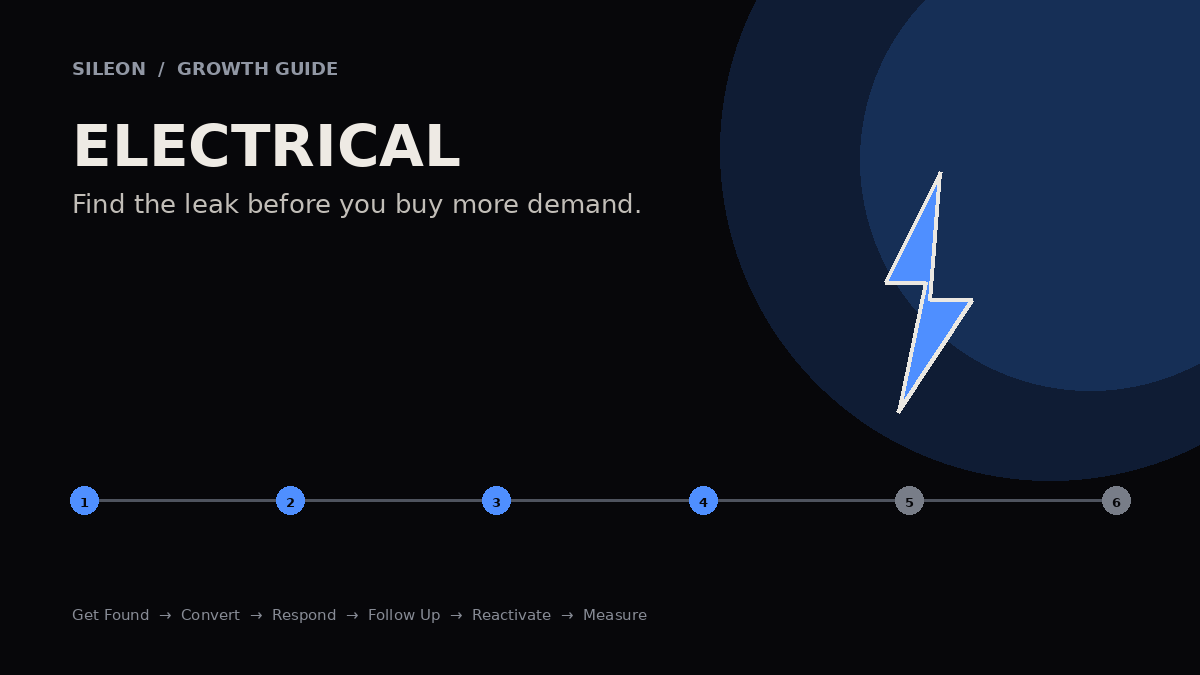
Electrical contractor customer acquisition growth map showing discovery, conversion, response, follow-up, reactivation and measurement.
Sileon’s six-station customer-acquisition framework applied to electrical growth.
Quick answers

Start with the constraint, not another tactic.

An electrician chasing more work needs to distinguish urgent service calls, planned residential projects and commercial bid cycles.

How do you grow an electrical contracting business?

Choose the work you actually want, then strengthen the path that produces it. Service calls, panel upgrades, generators, EV chargers, rewires and commercial projects do not share the same buying journey, so growth should be measured by right-fit booked work rather than raw lead count.

How do electricians get more customers?

Improve local discovery and service-page relevance for the work you want, show credible project and licensing information, make contact easy, and make sure inquiries have an owner. Follow-up matters especially for planned residential projects with longer decision cycles.

Should an electrical contractor follow up every estimate?

Planned residential estimates generally deserve a defined follow-up process, but commercial bids and general-contractor opportunities may follow different timelines and procurement rules. The follow-up system should match the work type rather than force every opportunity into one sequence.

What should an electrician measure in marketing?

Track which sources produce legitimate calls, forms and quote opportunities, then compare the types of jobs that actually book. Raw traffic and lead totals can be misleading when the work mix varies widely in value and fit.

The short answer

Define the electrical work you want more of, then fix the weakest step between discovery and booked work.

Start here

Which part of the electrical growth system is actually holding you back?

A bigger marketing budget only helps if the rest of the path can hold the demand. Use these symptoms to decide where to look first.

01
Get Found

The company is hard to find for the electrical services, customer types or service areas it actually wants.

Check get found →
02
Convert

The site does not clearly separate service work, larger projects or specialty offers, so prospects struggle to understand fit.

Check convert →
03
Respond

Calls and forms arrive while electricians or project managers are in the field and nobody owns the first response.

Check respond →
04
Follow Up

Panel, generator, EV, rewire or commercial quotes are sent without a reliable follow-up process.

Check follow up →
05
Reactivate

Past residential or commercial customers are not revisited even when a relevant future service need exists.

Check reactivate →
06
Measure

Marketing, referrals and project sources are not tracked consistently enough to guide the next growth decision.

Check measure →

1. Choose the electrical work you want to grow before you market harder.

Electrical contracting covers very different buying cycles. A residential service call, EV charger, panel upgrade, generator, full rewire and commercial project do not behave the same way. Trying to “get more electrician leads” without choosing the desired work can fill the pipeline with jobs the company does not actually want.

Define the priority services, customer types and service areas first. Then make the Google Business Profile, website, reviews and service content support those priorities clearly. Specialty work deserves depth when the business genuinely has the capability and proof to back it up.

What to inspect

  • Keep public categories, services and contact information accurate.
  • Build dedicated service content when a specialty offer has enough substance to deserve it.
  • Use real project proof and credentials where they help customers evaluate risk.
  • Develop local pages selectively, not as city-name clones.
  • Measure the quality of opportunities, not just the number of leads.
Sileon fit: If qualified discovery is the constraint, Search Growth is the relevant service. Use the Maps guide to check the local foundation first.

2. Make the website distinguish small service work from considered projects.

Electrical buyers can arrive with very different levels of urgency and complexity. A tripping breaker or outage-related service request needs a fast contact path. A panel upgrade, generator, EV charger or commercial project may require more explanation and trust before the customer requests an estimate.

The website should help each buyer understand whether the company handles the job, what the next step is and why the business is credible. Generic “residential and commercial” copy rarely does enough on its own.

What to inspect

  • Clarify priority residential, commercial and specialty services.
  • Put proof and process near higher-consideration project pages.
  • Test the mobile contact path for urgent service.
  • Make estimate requests simple without collecting unnecessary information.
  • Use analytics and inquiry data to separate low traffic from weak conversion.
Sileon fit: When the site is the weak point, start with why a website is not getting leads, then use Sileon’s conversion work only if the evidence supports it.

3. Build response around field reality.

Electrical contractors are often on jobs where answering every inbound call live is unrealistic. That does not mean the lead path has to depend on voicemail and memory. Calls, forms and quote requests should land in a visible process with an owner.

For a residential service business, that may mean immediate acknowledgement plus human callback. For commercial inquiries, it may mean routing enough project information to the right estimator or project manager. The workflow should match the actual business rather than forcing every inquiry into the same bot conversation.

What to inspect

  • Define who owns new residential and commercial inquiries.
  • Test missed calls and website forms from outside the office.
  • Use automated acknowledgement only where it is accurate and appropriate.
  • Keep handoffs visible until a person has taken responsibility.
Sileon fit: Customer Engine supports response and written follow-up. The missed-call guide is the right starting point for field-service businesses.

4. Do not let higher-value electrical quotes disappear after the site visit.

Electrical projects can have a longer decision cycle than an emergency service call. Panel work, generators, EV charging, rewires and commercial proposals may require budget approval, scheduling decisions, scope questions or comparison with other contractors.

The follow-up should reflect the project. Confirm the customer has what they need, answer a real question, give a clear way to move forward and close the loop when the opportunity is no longer active. A quote sent once and forgotten is not a sales process.

What to inspect

  • Assign ownership to every open written estimate.
  • Use project-specific follow-up instead of generic “checking in.”
  • Separate residential project timing from formal commercial bid cycles.
  • Record won, lost, postponed and no-decision honestly.
Sileon fit: The estimate follow-up guide shows a simple human process. Customer Engine can support that process when quote volume makes manual reminders unreliable.

5. Use past electrical customers when the next reason is legitimate.

Electrical work does not always repeat on a predictable monthly schedule, so reactivation should be selective. A prior customer may have a deferred project, older estimate, adjacent upgrade or maintenance need; a commercial account may have recurring service or facility work.

The fact that the business has a phone number is not enough. Segment by real history and timing, then communicate in a way that makes sense for the relationship.

What to inspect

  • Start with older estimates and known deferred work.
  • Use adjacent-service or maintenance needs only when they are genuinely relevant.
  • Treat commercial relationships differently from one-time residential customers.
  • Respect consent and stop signals.
Sileon fit: When there is a defensible audience and reason, Customer Reactivation can test it. The reactivation guide explains the standard.

6. Track which sources produce the kind of electrical work you want.

A referral for a commercial project and a search call for a small residential repair are both “leads,” but they may have very different value to the company. Measurement should preserve that distinction.

Connect calls and forms to available source information, then add a simple classification for service type or opportunity quality where the business can do it reliably. That is far more useful than a dashboard full of traffic with no connection to work.

What to inspect

  • Track real inquiries from calls and forms.
  • Record service type or project category where useful.
  • Use campaign tags on links the company controls.
  • Keep unknown source data honest instead of guessing.
Sileon fit: Tracking & Attribution helps connect inquiries to available source data. The lead-source guide gives the practical minimum.
The economics

Use your electrical job economics before deciding what another marketing channel is worth.

Enter gross profit and your own inquiry-to-booking scenario. The calculator does not assume an average panel, generator, EV or service-call value.

Run a simple scenario

Use what the business keeps from a typical booked job after direct labor and materials, not the full sale price.

Use a scenario you consider plausible. The calculator does not predict that Sileon will create the improvement.

Hypothetical additional gross profit / month
Enter your numbers

We’ll show the number of additional booked jobs implied by your scenario.

Know the limit

Customer acquisition is only one part of scaling an electrical company.

Licensed labor, estimating, project management, safety, cash flow, material availability and field capacity can become the true ceiling. More demand does not solve those constraints.

Where Sileon can help

Local search, website conversion, inquiry response, estimate follow-up, selective reactivation and source measurement.

Where we are not pretending to be the expert

Electrician recruiting, licensing, OSHA/safety systems, estimating methodology, project management, job costing, commercial bidding, material procurement or cash-flow consulting.

90-day order of operations

Fix the leak before you increase the pressure.

A practical sequence for an established electrical company that wants more of the right work.

01
Weeks 1–2

Choose the services and customer types the company wants more of, then map discovery, inquiry handling, estimates and source tracking.

Diagnose first
02
Weeks 2–4

Fix the biggest customer-acquisition constraint instead of pushing every service harder at once.

Repair the leak
03
Month 2

Build repeatable reviews, service proof, lead ownership and quote status so growth is less owner-dependent.

Create the system
04
Month 3

Expand channels or geography only after the team can absorb the work and measure the quality of new opportunities.

Add pressure carefully
Free growth audit

Want me to find the highest-value leak in your electrical customer path?

Send the business. I’ll review what I can verify across the website and public customer-acquisition path, explain where I would start, and tell you if the math does not justify hiring Sileon.