(845) 492-9707Free growth audit
Sileon Library  /  Roofing growth
Roofing business growth · Customer acquisition

How to grow a roofing business without buying your way around a broken customer path.

Roofing growth can look like a lead-generation problem when the real leak is somewhere else: weak local visibility, a trust gap on the website, storm-season calls nobody can answer, estimates that go quiet, an unused customer list or marketing nobody can measure.

By Nick Sileo · Updated September 2026Written for business owners, not marketersSix-station customer-acquisition frameworkNo ranking or revenue guarantees
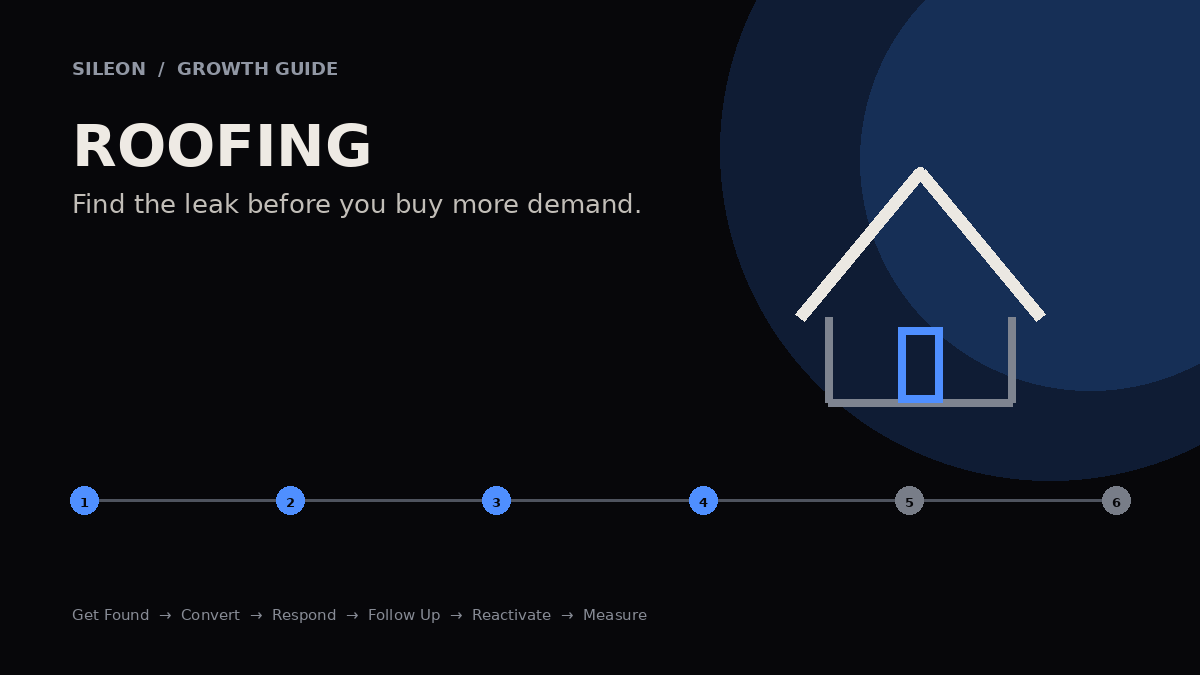
Roofing customer acquisition growth map showing search, conversion, response, estimate follow-up, reactivation and measurement.
Sileon’s six-station customer-acquisition framework applied to roofing growth.
Quick answers

Start with the constraint, not another tactic.

More roofing leads only help if inspections, estimates and follow-up are strong enough to turn demand into profitable jobs.

How do you grow a roofing business?

Separate demand problems from sales and production problems. Improve local discovery and trust when qualified homeowners are not finding you; improve estimate ownership and follow-up when opportunities exist but do not become jobs; add more demand only when capacity can support it.

How do roofing companies get more customers?

Build a reliable path from local search and referrals into clear inspection or estimate requests, then make sure those opportunities receive fast human response and consistent follow-up. The best channel depends on the kind of roofing work and the market you actually want.

What should a roofer fix before spending more on marketing?

Inspect the handoff after the lead: missed calls, slow inspection scheduling, unclear estimates, forgotten follow-up, weak project proof and poor source tracking can make additional lead spend look worse than it is.

How can a roofing company grow without relying only on storm leads?

Strengthen evergreen local visibility, referral capture, reputation, project proof and follow-up so the company is not dependent on one demand spike. Reactivation can help in selected situations, but it is not as universally valuable in roofing as it is in higher-frequency service businesses.

The short answer

Before buying more roofing leads, make sure the business can find, earn, respond to and close the demand it already has.

Start here

Which part of the roofing growth system is actually holding you back?

A bigger marketing budget only helps if the rest of the path can hold the demand. Use these symptoms to decide where to look first.

01
Get Found

Homeowners in the service area are not finding you often enough for the roof work you want.

Check get found →
02
Convert

People find you, but the site does not create enough trust to earn the inspection or estimate request.

Check convert →
03
Respond

Storms, active leaks and busy job sites create calls faster than the team can handle them.

Check respond →
04
Follow Up

Roof-replacement and repair estimates sit open without a defined next step.

Check follow up →
05
Reactivate

Past repair customers, older estimates and inspection opportunities are never revisited when there is a legitimate reason.

Check reactivate →
06
Measure

You know what you spend on marketing, but not which sources create qualified inspections and jobs.

Check measure →

1. Own the roofing searches that match your actual work.

Roofing is not one market. Emergency leak repair, full replacement, storm damage, commercial work, gutters and specialty systems can attract different buyers with different urgency. A roofing company trying to grow should decide which work it wants more of before expanding pages, ads or territory.

Local discovery starts with clear business information and useful service depth. The Google Business Profile, service pages, reviews and service-area information should make it obvious what the company does and where it actually works. Storm season can create a rush of attention, but the foundation has to exist before the weather hits.

What to inspect

  • Keep the Google Business Profile accurate, especially categories, hours, phone and real photos.
  • Build useful pages for the roofing services that matter commercially instead of thin keyword variants.
  • Use local pages only where real service-area knowledge, proof or market detail supports them.
  • Ask for genuine reviews consistently after completed work.
  • Prepare seasonal and storm-related content before demand spikes, not after.
Sileon fit: Discovery problems belong in Search Growth. The seasonal search guide is especially relevant to roofers who rely on weather-driven demand.

2. Make the website reduce risk before it asks for the estimate.

A roof is expensive, visible and consequential. Homeowners are not only comparing price; they are trying to reduce the risk of choosing the wrong contractor. A roofing site has to carry more trust than a generic “quality service” homepage.

Useful proof can include real project photos, service explanations, warranty language the company can actually stand behind, licensing or insurance information where appropriate, financing information when offered, a clear service area and a simple estimate path. The exact mix depends on the business, but the purpose is the same: make the next step feel safer.

What to inspect

  • Check whether the first mobile screen says what kind of roofer this is and where it works.
  • Put real project proof close to service and estimate decisions.
  • Explain the difference between repair, replacement and other priority services clearly.
  • Remove friction from inspection or estimate requests.
  • Test the website forms and phone links as a real customer would.
Sileon fit: If people are reaching the site but not contacting the company, use the website conversion diagnostic before assuming more traffic is the answer.

3. Build call handling for the days demand surges.

Roofing demand can be uneven. A normal week and the day after a major storm are not the same operational problem. The customer-acquisition system has to survive the moment when multiple calls arrive while crews, estimators and owners are already busy.

The goal is not to automate every roofing conversation. It is to remove avoidable silence: missed calls should be visible, web inquiries should land somewhere monitored, and somebody should own the handoff. If capacity is full, the system should still make the next step clear instead of making the lead disappear.

What to inspect

  • Map where calls and forms land during normal hours and after hours.
  • Use truthful automated acknowledgement only where appropriate and supported.
  • Make overflow inquiries visible to a person instead of burying them in voicemail.
  • Create a clear rule for who owns inspection and estimate requests.
Sileon fit: Customer Engine is useful when the business already creates demand but response is fragile. Read what should happen after a missed call first.

4. Treat every serious roofing estimate as an active opportunity until it is resolved.

A roof-replacement estimate can sit while a homeowner compares companies, talks to an insurer, works through financing, waits for another decision-maker or simply gets busy. Sending the estimate is not the same as finishing the sales process.

Good follow-up should answer questions and clarify the next step, not create fake urgency. Track whether the customer received the estimate, whether there is a real objection or timing issue, and whether the opportunity is still alive. Then stop when it is closed.

What to inspect

  • Assign an owner to every open estimate.
  • Confirm receipt and make questions easy.
  • Use the scope, timing, warranty or process to add useful context when appropriate.
  • Track won, lost and postponed instead of leaving estimates permanently “open.”
Sileon fit: The estimate follow-up guide gives a simple process. Customer Engine can make that process visible and repeatable when volume makes memory unreliable.

5. Use reactivation where roofing actually has a reason to reconnect.

Reactivation is not equally valuable for every roofer. A company focused almost entirely on one-time full replacements may have less repeat frequency than HVAC or plumbing. That does not mean the database is worthless; it means the reason to reach out has to be real.

Past repair customers, prior inspections, older estimates, maintenance relationships, commercial accounts or homeowners with deferred work can be relevant segments. A mass message to every old contact just because the number exists is not a strategy.

What to inspect

  • Segment by the prior relationship and real reason for contact.
  • Prioritize unsold estimates or customers where the service naturally creates a future need.
  • Use referrals and review requests as separate systems; do not disguise them as reactivation.
  • Respect opt-outs and channel permissions.
Sileon fit: Reactivation is a scoped campaign only when the audience and reason make sense. The reactivation guide explains the gate.

6. Track which channels create qualified roofing opportunities, not just clicks.

Roofers can spend across SEO, LSAs, search ads, directories, referrals, sponsorships and storm campaigns. The business needs enough source visibility to know which channels create real inspection or estimate opportunities.

Perfect attribution is unrealistic. A homeowner may see a truck, hear a referral, read reviews and search the company later. The goal is not false precision; it is enough evidence to make the next marketing decision better.

What to inspect

  • Track calls and forms as real inquiries first.
  • Record source information when it is available.
  • Distinguish qualified roofing opportunities from junk leads.
  • Keep an unknown bucket rather than forcing every job into a confident source.
Sileon fit: Use Tracking & Attribution when the spend is hard to evaluate. The lead-source guide shows the minimum useful setup.
The economics

Run the roofing math before you add another lead source.

Use your own gross profit, qualified-inquiry volume and close scenario. The output is arithmetic from your inputs, not an industry benchmark or Sileon forecast.

Run a simple scenario

Use what the business keeps from a typical booked job after direct labor and materials, not the full sale price.

Use a scenario you consider plausible. The calculator does not predict that Sileon will create the improvement.

Hypothetical additional gross profit / month
Enter your numbers

We’ll show the number of additional booked jobs implied by your scenario.

Know the limit

More roofing leads can be the wrong answer when production is already the constraint.

If crews, estimating capacity, cash flow, supplements, material ordering, project management or collections are the bottleneck, adding demand can amplify the problem.

Where Sileon can help

Local search, website trust and conversion, inquiry response, estimate follow-up, appropriate reactivation and lead-source measurement.

Where we are not pretending to be the expert

Roof installation operations, insurance-claim negotiation, supplements, crew hiring, production scheduling, material procurement, job costing or construction finance.

90-day order of operations

Fix the leak before you increase the pressure.

A practical sequence for an established roofing company that wants more of the right work.

01
Weeks 1–2

Map the path from local discovery to inspection request to estimate and job. Test calls/forms and identify where opportunities become invisible.

Diagnose first
02
Weeks 2–4

Fix the highest-value leak: search coverage, website trust, response ownership or estimate follow-up.

Repair the leak
03
Month 2

Systematize reviews, project proof, estimate status and source tracking so growth is less dependent on memory.

Create the system
04
Month 3

Only then expand demand with additional service areas, campaigns or paid channels that the operation has capacity to fulfill.

Add pressure carefully
Free growth audit

Want me to find the highest-value leak in your roofing customer path?

Send the business. I’ll review what I can verify across the website and public customer-acquisition path, explain where I would start, and tell you if the math does not justify hiring Sileon.