Skip to content
(845) 492-9707Free growth audit
Tree service growth · Customer acquisition

How to grow a tree service business when emergency calls and planned work behave completely differently.

Tree service has two customer journeys hiding inside one business: urgent storm or hazard calls, and planned removals, pruning or property work. Growth gets easier when the acquisition system recognizes that difference instead of treating every lead the same.

By · Updated For tree removal, pruning and arborist businessesSix-station customer-acquisition frameworkNo ranking or revenue guarantees
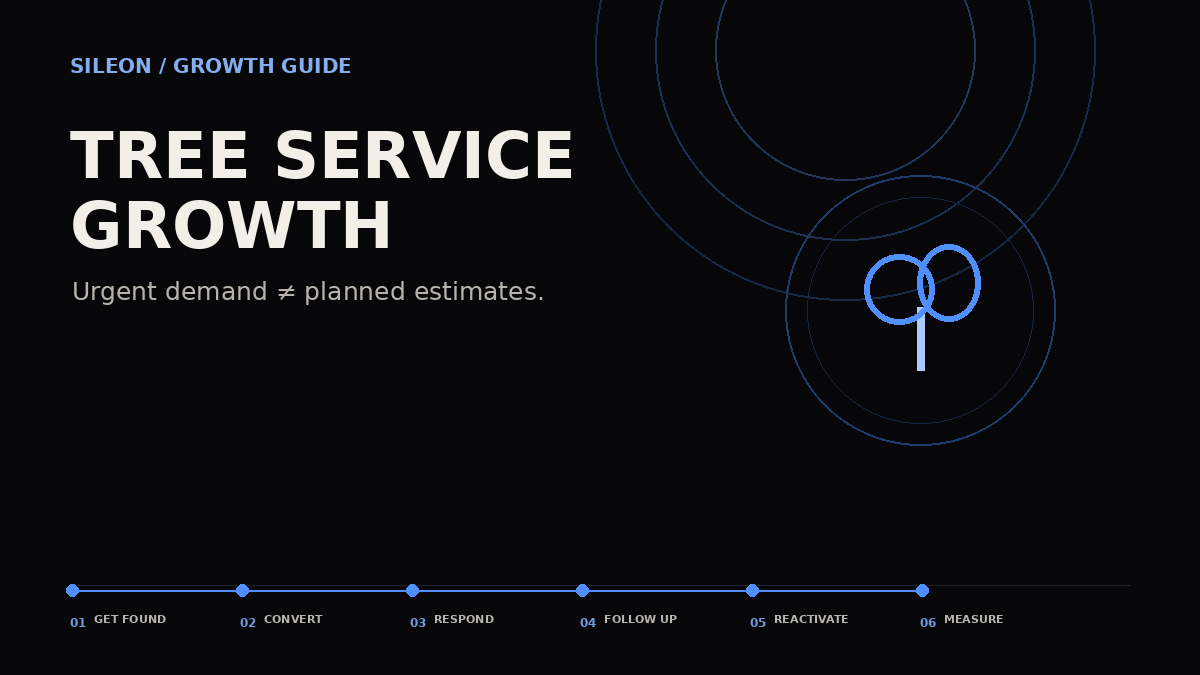
Tree service customer acquisition growth map showing Get Found, Convert, Respond, Follow Up, Reactivate and Measure.
Sileon’s six-station customer-acquisition framework applied to tree service company growth.
Quick answers

Build two paths: urgent response and planned work.

Emergency demand rewards availability and clear response expectations. Planned tree work rewards local proof, estimates and follow-up. The site and lead process should support both.

How do you grow a tree service business?

Separate emergency from planned demand, strengthen local discovery, make trust and service area clear, respond quickly to urgent inquiries, follow up on planned estimates and track which sources create booked work.

How do tree companies get more leads?

Google/Maps visibility, reviews, referrals and local content can help. The highest-value fix may also be better call handling or estimate follow-up on demand already arriving.

How do you scale a tree service company?

Standardize intake, urgency triage, estimator handoff, quote follow-up and source tracking. Crew, equipment and safety capacity remain operational constraints.

What should a tree service market first?

Prioritize the services and geography the company can safely and profitably handle—such as removals, pruning, stump work or emergency response—rather than chasing generic lead volume.

The six stations

Growth is easier to reason about when the customer journey is broken into observable stages instead of a pile of marketing tactics.

2-minute growth screen

Before buying more tree-service leads, run this 2-minute urgent-vs-planned screen.

Answer from what you can verify today. “Not sure” is useful: it usually means the measurement layer needs attention before anyone confidently prescribes more marketing.

Customer-acquisition screen0 / 6 answered
01Get Found

Can a local customer find the company for the priority tree work it actually handles, including emergency service only if that is truly offered?

02Convert

Can a homeowner understand what the company does, where it works and how to request the right kind of help from a phone?

03Respond

Does an urgent legitimate inquiry get a timely acknowledgement or clear expectation even when nobody is sitting at a desk?

04Follow Up

Can you see every viable planned-work estimate and when it should be revisited?

05Reactivate

Do satisfied customers or property managers have an appropriate way to remember the company for future tree needs?

06Measure

Do you know which channels create profitable planned work and which create urgent calls?

Screening result

Answer all six questions to see which station deserves inspection first.

Diagnose before prescribing

Identify whether the weak point is discovery, urgency handling or estimate follow-up.

A missed emergency call and an untouched pruning estimate are both acquisition leaks, but they require different fixes. Start by locating the stage, not by picking a marketing tactic.

01
Get Found

Check local visibility by service and urgency rather than one generic tree-service page.

Check Get Found →
02
Convert

Inspect service clarity, proof, insurance/credential claims and mobile contact path.

Check Convert →
03
Respond

Review missed-call handling, after-hours expectations and lead ownership.

Check Respond →
04
Follow Up

Inspect quote status and next actions for removals/pruning.

Check Follow Up →
05
Reactivate

Review annual/periodic needs, reviews and property-manager relationships.

Check Reactivate →
06
Measure

Connect source to service/urgency type and booked outcome.

Check Measure →
Industry lens

Tree-service growth has two speeds.

Urgent work needs a fast, truthful response path. Planned work needs proof, qualification and estimate follow-up. Mixing those journeys can create poor expectations for both customers and crews.

01

Urgency split

Do not promise emergency availability the company cannot support. When urgent response is offered, make routing and expectations explicit.

02

Safety trust

Insurance, credentials or arborist qualifications should only be shown when current and verifiable. Trust matters more than generic “best tree company” claims.

03

Estimate pipeline

Planned removals and pruning can sit open while homeowners compare options. Track them separately from emergency calls.

1. Get Found: Are you visible for both urgent and planned tree-service intent?

Tree-service search intent changes fast. A homeowner researching pruning can browse; someone with storm damage may call the first credible company that appears available.

The discovery layer should make those differences clear while staying accurate about service capability.

What to inspect

  • tree removal, pruning, stump or other real service pages
  • Google Business Profile relevance and current service area
  • emergency wording that matches actual availability
  • storm/season content that does not overpromise response
Urgency is not a keyword trickDo not advertise 24/7 or emergency response unless the business can actually support it. False urgency claims destroy trust and create bad leads.

What improvement would actually mean

Improvement means qualified discovery grows for real services and service areas, with urgent and planned demand distinguishable.

2. Convert: Does the site establish safety, capability and the next step quickly?

Tree work carries obvious perceived risk. A generic site with little proof can make even an experienced company look uncertain.

Conversion should focus on credible capability and next-step clarity—not dramatic fear language or unsupported safety claims.

What to inspect

  • service and emergency/planned paths
  • verifiable insurance/credential information if published
  • project photos and reviews
  • one-tap call/contact on mobile without clutter
Confidence without scare tacticsExplain the service and evidence. Do not manufacture urgency around ordinary planned work just to force a call.

What improvement would actually mean

Improvement means relevant visitors can quickly choose the correct contact path and more good-fit inquiries reach the business.

3. Respond: Can urgent inquiries be acknowledged while crews are in the field?

Tree crews are often operating equipment where immediate phone access is unrealistic. The response system should account for that instead of assuming the owner can answer every ring.

A fast automated acknowledgement can confirm receipt, but it should not imply that a crew is dispatched or a dangerous situation is safe.

What to inspect

  • missed-call process
  • after-hours message/voicemail expectations
  • who owns urgent web forms or calls
  • planned-work intake separated from emergencies
Acknowledge, do not overpromiseResponse systems can improve communication. They cannot replace emergency services or professional onsite safety judgment.

What improvement would actually mean

Improvement means legitimate urgent inquiries are less likely to disappear and planned requests enter a visible estimate path.

4. Follow Up: Are planned tree estimates followed after the site visit?

Planned removals, pruning and property work often involve comparison shopping or delayed timing. Without a follow-up system, the business may assume “they went with someone else” when the customer simply has not decided.

Respectful follow-up can recover visibility without pestering homeowners.

What to inspect

  • estimate date and service type
  • next follow-up
  • customer timing or season notes
  • accepted/lost/deferred status
Separate planned work from emergenciesEmergency calls should not sit in the same follow-up logic as a non-urgent pruning proposal.

What improvement would actually mean

Improvement means viable planned estimates remain visible until a real decision is known.

5. Reactivate: Are past customers and property relationships generating appropriate repeat work?

Trees create recurring needs over time, especially for properties with many mature trees. Past work can also establish confidence for future removals or storm events.

Reactivation should be based on a real relationship or maintenance context, not a generic fear-based message about tree safety.

What to inspect

  • post-job review request
  • past-customer service history
  • property manager/HOA relationships where relevant
  • permission-aware seasonal reminders only when useful
Use the history you actually haveA past pruning or removal gives context for future communication, but it does not justify diagnosing new risk from a database.

What improvement would actually mean

Improvement means more appropriate repeat/referral conversations from known relationships.

6. Measure: Can you tell which source creates emergency work versus planned jobs?

Storm periods can temporarily flood one channel with calls, while steady local search or referrals may support planned work across the year.

Without separating those categories, the business can make bad marketing decisions based on one unusual week.

What to inspect

  • lead source
  • service/urgency category
  • estimate or immediate booking status
  • booked job and geography
Tag urgency at intakeA source is easier to evaluate when the business knows what kind of work it produced.

What improvement would actually mean

Improvement means the owner can compare sources by service mix and booked outcomes.
Decision rules

Do you need more tree-service leads — or better urgent response and planned-estimate follow-up?

The answer depends on which journey is leaking. A company can have strong emergency call volume and still need more planned work—or the reverse.

#What you observeWhat I would inspect first
01
Priority tree services are barely visible locally.
Inspect Get Found by service, area and urgency.
02
Visitors land but do not trust or understand the service path.
Inspect Convert: proof, service clarity and mobile contact.
03
Urgent calls/forms are missed while crews work.
Inspect Respond and missed-call acknowledgement.
04
Planned estimates are sent and forgotten.
Inspect Follow Up separately from emergency intake.
05
Past property clients never hear from the company again.
Inspect appropriate relationship/reactivation opportunities.
06
Crews/equipment cannot safely take more work.
Do not add demand until field capacity is addressed.
What Sileon would actually change

Match the work to the leak.

A diagnosis only matters if it changes what gets done. These are example directions, not a promise that every business needs every service.

#Station and likely workRoute
01
Get Found

Strengthen local visibility for the actual tree services and markets the company handles.

See Search Growth →
02
Convert

Clarify urgent vs planned paths and show credible, verifiable proof.

See websites & CRO →
03
Respond

Create missed-call and inquiry acknowledgement that sets truthful expectations.

See Customer Engine →
04
Follow Up

Give planned estimates a clear owner and next step.

See Customer Engine →
05
Measure

Separate emergency and planned demand in source reporting.

See Tracking →
Sileon rule: If the constraint is crew safety, equipment, staffing or storm-response capacity, I would not recommend more demand. I would also never market emergency availability the company cannot truthfully provide.
Owner-input economics

What is one more booked tree job worth in the service category you want?

Use your own gross-profit and opportunity numbers. This is scenario math, not an industry benchmark, forecast or Sileon promise.

Test a conversion scenario

Use your own gross profit and separate emergency, removal, pruning or recurring property work if their economics differ. The calculator is a scenario tool, not a tree-service benchmark.

Use gross profit rather than revenue if you can. If you do not know the inputs, that is a measurement problem worth fixing first.

Hypothetical change in gross profit / month
Enter your numbers

This calculator only compares two owner-provided conversion scenarios.

Prove the repair

Separate urgent calls from planned estimate outcomes.

The metric should match the station. Rankings, traffic or automation activity are not enough by themselves if the business cannot connect them to an acquisition outcome.

#StationSignal to verify
01
Get Found

Track search discovery and qualified calls/forms by service and urgency type.

02
Convert

Track qualified calls/forms from urgent and planned service pages separately.

03
Respond

Track missed-call recovery, acknowledgement and booked estimate/emergency next steps.

04
Follow Up

Track open planned estimates, follow-ups, booked jobs and deferment reasons.

05
Reactivate

Track repeat inquiries, reviews, referrals and legitimate relationship-based outreach.

06
Measure

Track source → urgency/service type → estimate/booking → completed opportunity.

The standard: establish a baseline, change one understandable system, and watch the signal tied to that station. Avoid claiming a win from a metric that never reaches the customer journey.
When marketing is not the problem

Tree-service growth cannot outrun safety and equipment capacity.

A lead-generation system should never pressure the business into accepting work it cannot staff, equip or perform safely. When field capacity is the limit, acquisition should wait.

Where Sileon can help

  • local search visibility by tree service
  • website trust and urgent/planned routing
  • missed-call and inquiry acknowledgement
  • planned-estimate follow-up
  • review/referral and appropriate relationship reactivation
  • source/urgency tracking

Where I would not pretend to be the expert

  • arboricultural diagnosis and treatment decisions
  • climbing, rigging and removal technique
  • crew safety and training
  • equipment/fleet capacity
  • storm-response field operations
  • insurance, licensing and regulatory compliance
90-day order of operations

Separate the two customer journeys before trying to scale them.

Use the first 90 days to map urgent versus planned demand, fix the larger leak, and then judge whether additional visibility is needed.

01
Days 1–30 · Tag the work

Separate urgent/planned leads, priority services, current sources, missed calls and open estimates.

Sequence, then measure
02
Days 31–60 · Repair the weak journey

Improve discovery/response for urgent demand or proof/follow-up for planned work based on the baseline.

Sequence, then measure
03
Days 61–90 · Measure service mix

Compare booked work by source and urgency, then expand the acquisition channel that supports the desired mix.

Sequence, then measure
Free growth audit

Want to know whether your tree-service leak is urgent response, planned estimates or visibility?

The free growth audit separates the customer journeys first, then recommends work only where the evidence points.