Skip to content
(845) 492-9707Free growth audit
Painting company growth · Customer acquisition

How to grow a painting business without letting seasonality and slow estimate follow-up control the pipeline.

Painting companies often have two very different growth problems: getting enough of the right projects into the calendar and converting estimates efficiently when demand is already strong. A six-station view helps separate visibility, trust, response, follow-up, repeat work and measurement.

By · Updated For residential and commercial painting companiesSix-station customer-acquisition frameworkNo ranking or revenue guarantees
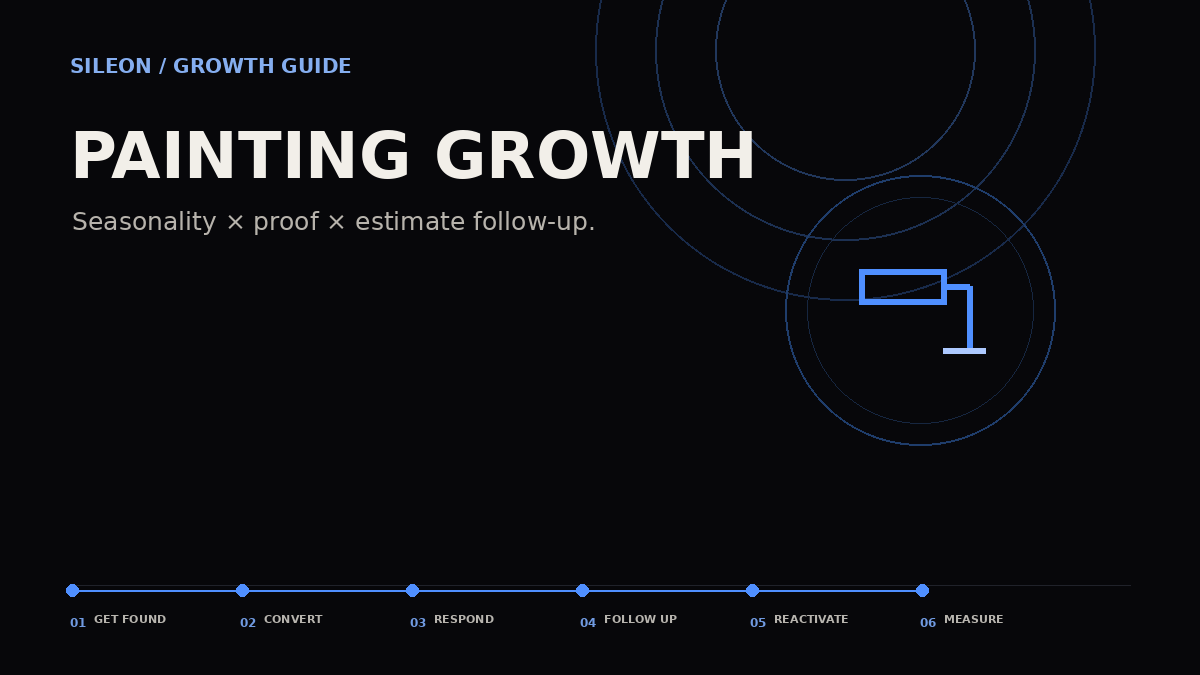
Painting company customer acquisition growth map showing Get Found, Convert, Respond, Follow Up, Reactivate and Measure.
Sileon’s six-station customer-acquisition framework applied to painting company growth.
Quick answers

Control the calendar instead of reacting to it.

The useful growth question is not only “how do I get painting leads?” It is how to build a steadier path from local discovery to booked interior, exterior or commercial work.

How do you grow a painting business?

Target the painting services and markets you want, show relevant work, respond quickly to estimate requests, follow up on open quotes, reactivate appropriate past clients and track which sources create booked projects.

How do painters get more customers?

Local search, referrals, neighborhood visibility and repeat customers can all matter. First verify whether the current leak is demand, quote conversion or seasonal planning.

How do you scale a painting company?

Standardize lead response, estimate follow-up, review/referral requests and source tracking so sales does not live only in the owner’s phone. Crew capacity still has to scale separately.

What should a painting company market first?

Prioritize the work you want—interior, exterior, cabinet, commercial, etc.—and the geography you can serve efficiently. Generic traffic is less useful than project-fit demand.

The six stations

Growth is easier to reason about when the customer journey is broken into observable stages instead of a pile of marketing tactics.

2-minute growth screen

Before buying more painting leads, run this 2-minute calendar-and-estimate screen.

Answer from what you can verify today. “Not sure” is useful: it usually means the measurement layer needs attention before anyone confidently prescribes more marketing.

Customer-acquisition screen0 / 6 answered
01Get Found

Can homeowners or property managers find you for the painting work you most want to book right now?

02Convert

Can a visitor quickly see relevant painting work, understand what you paint and request an estimate without friction?

03Respond

Does every legitimate estimate request get acknowledged and routed to the right person even while crews are painting?

04Follow Up

Can you see which painting estimates are open, when they were sent and when they should be revisited?

05Reactivate

Do satisfied past customers have an appropriate path to book another area, refer a neighbor or leave a review?

06Measure

Can you compare sources by booked painting work instead of lead count alone?

Screening result

Answer all six questions to see which station deserves inspection first.

Diagnose before prescribing

Separate a demand shortage from an estimate-conversion problem.

Painting is seasonal in many markets, visual by nature and often estimate-driven. The same “slow month” can be caused by weak discovery, weak proof, slow response or a pile of open quotes.

01
Get Found

Check service-specific search visibility and local relevance by season and job type.

Check Get Found →
02
Convert

Inspect project photos, service clarity, reviews and estimate CTA.

Check Convert →
03
Respond

Check ownership and response process for calls/forms.

Check Respond →
04
Follow Up

Inspect quote status, next follow-up and scheduling readiness.

Check Follow Up →
05
Reactivate

Review repaint cycles, review/referral process and legitimate seasonal touchpoints.

Check Reactivate →
06
Measure

Connect source to service type, estimate and booked job.

Check Measure →
Industry lens

Painting growth is a calendar-management problem as much as a lead problem.

The acquisition system should support the mix of work the company wants throughout the year, then move estimates quickly enough that crews are not waiting on decisions the owner forgot to follow up.

01

Seasonal demand map

Interior, exterior and commercial demand can behave differently. Build visibility and follow-up around the work that makes sense for each part of the calendar.

02

Photo proof that sells scope

Show clean, relevant project examples with service context—not just an endless gallery. Help the visitor recognize their project.

03

Quote-to-calendar handoff

An accepted estimate only becomes useful growth when scheduling, ownership and the next customer communication are clear.

1. Get Found: Are you visible for the painting services that fill the right calendar gaps?

Painting companies can experience a calendar problem even when overall lead volume looks acceptable. The mix matters: exterior work may not solve a winter gap, and small touch-ups may not fit a crew built for larger repaints.

Search and local visibility should support a deliberate service mix rather than treating every click as equal.

What to inspect

  • interior/exterior/cabinet/commercial service pages where appropriate
  • Google Business Profile categories, photos and service areas
  • seasonal content timed before demand peaks
  • local pages only where there is real service relevance
Market the calendar you wantThe best keyword is not useful if the resulting job does not fit the season, crew or economics.

What improvement would actually mean

Improvement means more qualified discovery for the services and markets that fit the current growth plan.

2. Convert: Does the site make the quality of the work easy to judge?

Painting is unusually visual. Homeowners want to know whether the company produces clean lines, protects the home and finishes work professionally, but they also need to know whether the business does their type of project.

Conversion improves when visual evidence is organized around real buying questions instead of existing only as decoration.

What to inspect

  • project images tied to actual services
  • clear prep/finish/process explanations where useful
  • verifiable reviews and trust signals
  • mobile estimate-request path
Proof should answer “can they do my project?”A gallery that looks good but does not connect to service type or scope leaves the visitor to do the interpretation.

What improvement would actually mean

Improvement means relevant visitors request estimates at a higher useful rate without lowering project fit.

3. Respond: Are estimate requests acknowledged before the shopper moves on?

Painters spend much of the day away from a desk. That makes missed calls and delayed form response an acquisition problem, not merely an administrative inconvenience.

The response system should confirm that the business received the request and set the next expectation without pretending to quote a job unseen.

What to inspect

  • who monitors calls/forms during field work
  • after-hours acknowledgement
  • basic service/location qualification
  • clear expectation for estimate scheduling
Field work cannot make leads invisibleIf response depends on the owner checking a phone between jobs, qualified demand can disappear for reasons unrelated to marketing.

What improvement would actually mean

Improvement means legitimate estimate requests receive consistent acknowledgement and scheduling ownership.

4. Follow Up: Are open estimates managed like a pipeline?

Painting estimates are easy to send and easy for homeowners to postpone. A simple follow-up system can be especially useful when the prospect is waiting on color decisions, weather, a move date or another contractor.

The point is not to chase every quote forever. It is to stop good-fit estimates from disappearing because nobody owns the next touch.

What to inspect

  • estimate sent date
  • next follow-up date
  • project timing/season notes
  • accepted/lost/deferred status
Open quotes are inventoryUntil an estimate is accepted, declined or intentionally deferred, it represents acquisition effort that should be visible.

What improvement would actually mean

Improvement means fewer good-fit estimates die silently and the calendar is easier to forecast.

5. Reactivate: Can past customers create repeat and referral demand at the right time?

A painting client may later need another room, exterior work, cabinets or a rental turnover. That makes the past-customer list valuable when it is used with context rather than generic blasts.

Neighborhood visibility can also compound because painted homes are physically visible proof.

What to inspect

  • post-job review request
  • referral prompt after satisfaction is confirmed
  • past-customer service history
  • permission-aware seasonal or related-service outreach
Use context, not spamA relevant “you hired us for X; here is Y” touchpoint is different from sending every former customer the same promotion.

What improvement would actually mean

Improvement means appropriate repeat/referral conversations increase without eroding trust.

6. Measure: Do you know which sources fill the calendar with the right work?

One channel may create many small interior inquiries while another creates fewer but larger exterior or commercial jobs. Without service-level attribution, those sources can look deceptively similar.

Useful measurement gives the owner a way to decide where to invest before the calendar gets thin.

What to inspect

  • source captured at inquiry
  • service type and geography
  • estimate status
  • booked job and timing
Tie marketing to booked scopeThe metric that matters is not “leads generated”; it is whether the source creates the work the company is built to deliver.

What improvement would actually mean

Improvement means the owner can see which sources contribute to the desired service mix and schedule.
Decision rules

Do you need more painting leads — or better estimate conversion and seasonal planning?

A slow calendar can come from several different stations. Diagnose the specific break before spending more on traffic.

#What you observeWhat I would inspect first
01
The next season is approaching and priority-service visibility is weak.
Inspect Get Found and build demand before the calendar gap arrives.
02
People view project pages but rarely request estimates.
Inspect Convert: service clarity, proof and mobile CTA friction.
03
Estimate requests come in but callbacks are inconsistent.
Inspect Respond before buying more demand.
04
Quotes are sent but many sit untouched.
Inspect Follow Up and open-estimate ownership.
05
Past clients could plausibly need related work but there is no system.
Inspect appropriate Reactivation and referral workflows.
06
Crews are already maxed out for the next several months.
Do not increase demand until staffing/scheduling can support it.
What Sileon would actually change

Match the work to the leak.

A diagnosis only matters if it changes what gets done. These are example directions, not a promise that every business needs every service.

#Station and likely workRoute
01
Get Found

Build service- and season-specific visibility for the painting work the company wants next.

See Search Growth →
02
Convert

Organize visual proof and service pages around the homeowner’s actual decision.

See websites & CRO →
03
Respond

Create a reliable acknowledgement and estimate-scheduling path while crews are in the field.

See Customer Engine →
04
Follow Up

Track every open quote and assign a respectful next step.

See Customer Engine →
05
Reactivate

Use appropriate past-customer and referral touchpoints tied to real service history.

See Reactivation →
Sileon rule: If the calendar is full and the bottleneck is crew capacity, I would not recommend more demand. If the issue is open estimates, I would fix follow-up before trying to double lead volume.
Owner-input economics

How many additional booked painting jobs would cover the system?

Use your own gross-profit and opportunity numbers. This is scenario math, not an industry benchmark, forecast or Sileon promise.

Test a conversion scenario

Use gross profit from your actual target service mix. If interior, exterior and commercial work have very different economics, run separate scenarios rather than pretending one average describes the business.

Use gross profit rather than revenue if you can. If you do not know the inputs, that is a measurement problem worth fixing first.

Hypothetical change in gross profit / month
Enter your numbers

This calculator only compares two owner-provided conversion scenarios.

Prove the repair

Measure the service mix that actually reaches the schedule.

The metric should match the station. Rankings, traffic or automation activity are not enough by themselves if the business cannot connect them to an acquisition outcome.

#StationSignal to verify
01
Get Found

Track service-specific impressions and qualified estimate requests by page and season.

02
Convert

Measure qualified estimate requests from priority service pages and proof interactions.

03
Respond

Track acknowledgement, estimate scheduling and lost-contact reasons.

04
Follow Up

Track open estimates, completed follow-ups, accepted work and deferrals by timing.

05
Reactivate

Track repeat jobs, referrals, reviews and the outreach that created a real conversation.

06
Measure

Track source → service type → estimate → booked job → scheduled period.

The standard: establish a baseline, change one understandable system, and watch the signal tied to that station. Avoid claiming a win from a metric that never reaches the customer journey.
When marketing is not the problem

A full painting schedule can hide a capacity bottleneck.

If the company cannot staff, supervise or schedule more work, more estimate requests may only lengthen response times and hurt the customer experience. Fix the operating constraint before adding demand.

Where Sileon can help

  • local/service-specific search visibility
  • website proof and estimate conversion
  • inquiry acknowledgement
  • estimate follow-up
  • appropriate repeat/referral/reactivation systems
  • source and booked-job tracking

Where I would not pretend to be the expert

  • crew recruiting and retention
  • paint/labor estimating methodology
  • job scheduling and field supervision
  • materials and supplier management
  • quality-control procedures
  • cash flow and production operations
90-day order of operations

Build demand before the gap, then protect every estimate.

A sensible 90-day sequence should reflect the calendar. That may mean strengthening visibility ahead of a season while tightening estimate handling at the same time.

01
Days 1–30 · Map calendar + funnel

Identify desired service mix, upcoming gaps, sources, response process and open-estimate workflow.

Sequence, then measure
02
Days 31–60 · Repair discovery or conversion

Strengthen the station most likely to affect the next calendar window, including proof or follow-up where needed.

Sequence, then measure
03
Days 61–90 · Compare booked work

Measure qualified estimates and booked jobs by service/source, then decide where additional demand is justified.

Sequence, then measure
Free growth audit

Want to know whether your painting bottleneck is demand, estimates or the calendar?

The free growth audit looks across the whole customer-acquisition path instead of assuming you need another lead source.