How do you grow a cleaning business?
Improve local visibility, make services and recurring options clear, respond to quote requests quickly, onboard clients well, retain/re-engage appropriate customers and measure source-to-recurring outcomes.
Cleaning growth can look strong on lead volume while recurring-client retention stays weak. A healthier acquisition system connects local discovery, fast quoting, clear service expectations, dependable onboarding, retention and route-aware measurement.
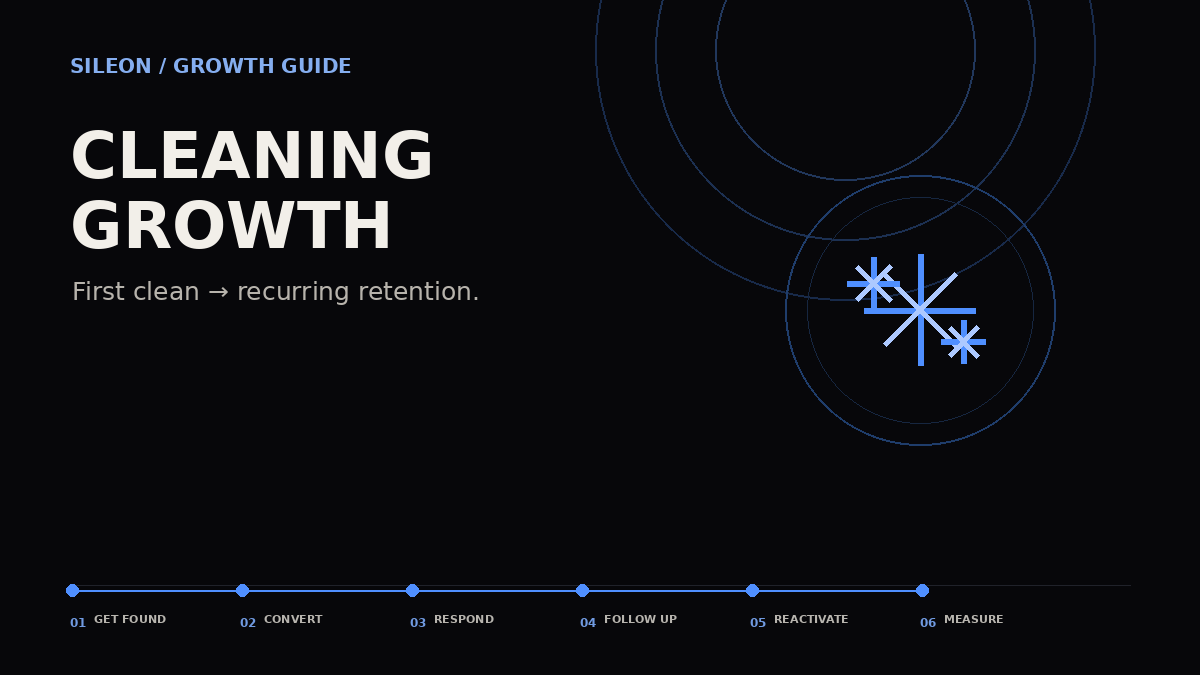
A cleaning company can grow by adding new customers, improving how many first-time customers become recurring, retaining good accounts and making routes more efficient.
Improve local visibility, make services and recurring options clear, respond to quote requests quickly, onboard clients well, retain/re-engage appropriate customers and measure source-to-recurring outcomes.
Local search, reviews, referrals, neighborhood density and commercial relationships can all help. Better response and recurring conversion may create growth before more lead spend is needed.
Standardize quoting, onboarding, recurring scheduling, cancellation/reactivation and source tracking. Cleaner staffing, quality control and route operations still have to scale separately.
Prioritize the client type and service model you actually want—recurring residential, deep cleans, move-outs, offices, etc.—instead of treating every cleaning inquiry as equally valuable.
Growth is easier to reason about when the customer journey is broken into observable stages instead of a pile of marketing tactics.
Answer from what you can verify today. “Not sure” is useful: it usually means the measurement layer needs attention before anyone confidently prescribes more marketing.
Can a customer in the desired service area find the company for the exact cleaning service it truly offers?
Can a prospect understand what kind of cleaning you do, whether recurring service is available and how to get an accurate quote?
Does every legitimate cleaning inquiry get a prompt acknowledgement and clear next step even during active jobs?
After the first clean, is the client clear on scope, frequency, communication and the next scheduled service?
Do you know which former customers are genuinely appropriate to contact again—and why?
Can you compare acquisition channels by retained customer outcomes instead of the first booking alone?
Answer all six questions to see which station deserves inspection first.
The most expensive cleaning lead is not necessarily one with a high ad cost; it can be a good customer who books once and leaves because the handoff or service expectations were weak.
Check local visibility by residential/commercial/service intent and target geography.
Check Get Found →Inspect service inclusions, trust, frequency options and quote/booking path.
Check Convert →Review customer history, cancellation reason and seasonal/related services.
Check Reactivate →New customers matter, but recurring relationships and route density can change the economics. The acquisition system should track both the first booking and what happens afterward.
If recurring service is a core offer, make the cadence, scope and next step clear instead of hoping a one-time clean naturally converts.
Neighborhood concentration can matter for recurring residential work. Measure geography rather than assuming every service-area customer has equal operational value.
A cancelled customer may have left for price, quality, schedule, a move or a one-time need. Reactivation only makes sense when the reason supports it.
Cleaning companies often market every service equally even when recurring residential, move-outs and offices have different economics and staffing requirements.
Visibility should reflect the client mix the business wants rather than simply maximizing generic cleaning traffic.
Improvement means more qualified discovery from the client/service categories the company wants.
Cleaning prospects often want quick answers about scope, frequency and trust. A vague page can create price-shopping inquiries that do not fit the company’s model.
The site should be specific enough to set expectations without publishing a fake universal price if pricing depends on home size, condition or scope.
Improvement means more qualified quote/booking requests and fewer expectation mismatches.
Cleaning owners and managers are often coordinating staff and jobs rather than sitting at a desk. Slow response can push prospects to continue shopping.
The first reply should establish the next step without promising a price before the company has enough information.
Improvement means legitimate inquiries reach a quote or booking step consistently.
For a recurring model, the sale is not complete at the first clean. Onboarding and service communication shape whether the client stays.
A one-time customer should not be pressured into recurring service if that is not what they need. The offer should be explicit and appropriate.
Improvement means more appropriate first-time clients become retained recurring customers and fewer churn for preventable expectation issues.
A customer who paused because they traveled, moved or changed schedules is different from one who cancelled after a service issue. Treating them all the same makes reactivation less credible.
Context-aware follow-up can help recover appropriate relationships without turning the list into spam.
Improvement means appropriate former clients rebook while opt-outs and poor-fit customers remain respected.
A channel that produces many one-time cleans may be useful, but it is not automatically better than a source that produces fewer recurring clients. The answer depends on the company’s own margin and staffing model.
Source reporting should preserve recurring status and geography when those materially affect value.
Improvement means the owner can judge sources by client model, route fit and retained outcome.
If the business already gets first-time customers but loses them quickly, more lead volume can hide the real problem.
A diagnosis only matters if it changes what gets done. These are example directions, not a promise that every business needs every service.
Strengthen local visibility for the client and cleaning-service mix the business wants.
Clarify scope, frequency and trust so the right prospect can request a quote confidently.
Strengthen the first-clean-to-recurring onboarding path where recurring service fits.
Use your own gross-profit and opportunity numbers. This is scenario math, not an industry benchmark, forecast or Sileon promise.
Use the business’s own gross profit per service or recurring relationship. One-time, recurring residential and commercial accounts can have different economics, so model the path you actually want to grow.
Use gross profit rather than revenue if you can. If you do not know the inputs, that is a measurement problem worth fixing first.
This calculator only compares two owner-provided conversion scenarios.
The metric should match the station. Rankings, traffic or automation activity are not enough by themselves if the business cannot connect them to an acquisition outcome.
Track service-specific search discovery and qualified quote/booking requests by area.
Track qualified requests by service/frequency and common disqualification reasons.
Track acknowledgement, quote completion and booking outcome.
Track first clean, recurring enrollment, active/cancelled status and cancellation reason.
Track reactivation segment, response, rebooking and opt-out rate.
Track source → service/frequency → area → booked → retained/cancelled status.
More customers do not help if cleaner availability, supervision or route schedules cannot protect service quality. Acquisition should support a reliable recurring operation.
Use the first 90 days to map the desired client model, repair the weak acquisition/retention station and compare real retained outcomes by source.
Baseline service mix, sources, quote response, first cleans, recurring clients, cancellations and route areas.
Sequence, then measureImprove local discovery, quote conversion, response or recurring onboarding based on the evidence.
Sequence, then measureCompare booked and retained clients by source/area, then expand demand only where service quality can support it.
Sequence, then measureThe free growth audit looks at discovery, quoting, onboarding, retention and measurement before recommending more lead volume.