(845) 492-9707Free growth audit
Sileon Library  /  Home service growth
Home service business growth · Customer acquisition

How to grow a home service business by fixing the constraint before adding more pressure.

Growing a home service company is not one marketing tactic. It is a system: the right customer has to find you, trust you, reach you, get a response, receive useful follow-up, have a reason to come back and leave enough data for you to know what worked.

By Nick Sileo · Updated September 2026Written for business owners, not marketersSix-station customer-acquisition frameworkNo ranking or revenue guarantees
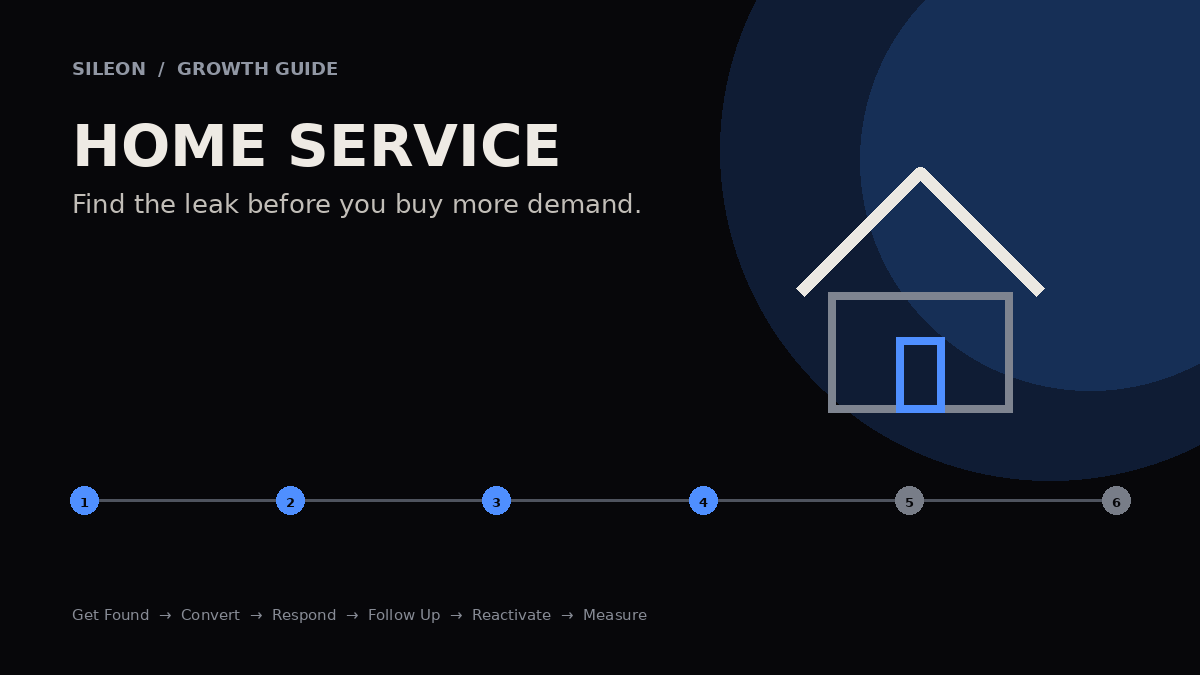
Home service customer acquisition framework with six stations: Get Found, Convert, Respond, Follow Up, Reactivate and Measure.
Sileon’s six-station customer-acquisition framework applied to home service growth.
Quick answers

Start with the constraint, not another tactic.

Growth gets easier when you stop treating “marketing” as one problem and find the exact customer-acquisition station that is limiting booked work.

How do you grow a home service business?

Find the current constraint first. A business can stall because too few customers discover it, the website fails to create trust, inquiries are mishandled, estimates are not followed up, past customers disappear, or nobody can tell which marketing produces booked work.

How do you get more customers for a service business?

Improve the weakest part of the customer path before adding another channel. More visibility helps when demand is the constraint; better response and follow-up help when the business already receives opportunities but loses them after contact.

What should a home service business fix before scaling marketing?

Confirm capacity, make sure the website and contact path work, assign inquiry ownership, create a follow-up rule, and establish basic source tracking. Scaling demand into an unreliable process usually scales the leaks too.

How do you know which marketing to invest in?

Track enough of the chain from source to legitimate inquiry to booked work to compare channels. Then use customer value and gross-profit math to decide whether improving a weak station or adding more demand is the better next investment.

The short answer

The best next growth move depends on which station is losing the most value — and sometimes the real constraint is operations, not marketing.

Start here

Which part of the home service growth system is actually holding you back?

A bigger marketing budget only helps if the rest of the path can hold the demand. Use these symptoms to decide where to look first.

01
Get Found

Not enough qualified customers are discovering the business for the services and geography that make economic sense.

Check get found →
02
Convert

The business gets attention, but its website, profiles or proof do not turn enough of that attention into conversations.

Check convert →
03
Respond

Calls and forms arrive, but the first response is inconsistent or invisible.

Check respond →
04
Follow Up

Quotes and open opportunities depend on memory instead of a clear next step.

Check follow up →
05
Reactivate

Past customers and older opportunities are never revisited even when there is a legitimate reason.

Check reactivate →
06
Measure

The owner spends on marketing without enough source and outcome data to know what deserves the next dollar.

Check measure →

1. Create the right opportunities, not just more opportunities.

Home service businesses grow more sustainably when demand matches capacity, service mix and economics. An HVAC company may prioritize replacements; a roofer may want inspections and replacements; a plumber may value urgent service plus larger projects; an electrician may focus on upgrades; a landscaper may want dense maintenance routes or larger design/build work.

That means the first growth question is not “Which marketing channel?” It is “Which customers and jobs do we want more of?” Once that is clear, local search, service pages, reviews and paid channels can be evaluated against a real business goal.

What to inspect

  • Define the services and geography worth growing.
  • Make the Google Business Profile and website reflect the real offer.
  • Use reviews and first-party proof to reduce buyer uncertainty.
  • Build useful service depth instead of mass-producing keyword pages.
  • Evaluate opportunity quality, not raw lead count.
Sileon fit: When discovery is weak, Search Growth is the relevant Sileon service. The Google Maps guide and review guide cover the foundation.

2. Convert existing attention before paying to amplify it.

A home service website should make the business understandable and trustworthy quickly on a phone. Customers need to know what the company does, where it works, why it is credible and what to do next.

When traffic exists but inquiries are weak, buying more clicks can simply send more people through the same conversion problem. Test the destination first, then decide whether the bottleneck is traffic, trust, offer clarity, contact friction or something after the inquiry.

What to inspect

  • Test the first mobile screen for clarity.
  • Use real proof near the service and decision it supports.
  • Make calls and forms easy without hiding essential information.
  • Give priority services enough content to answer genuine buying questions.
  • Check forms and phone links yourself before blaming traffic.
Sileon fit: Use the ten-minute website lead test before paying for more demand.

3. Treat response as part of the acquisition system.

Home service owners and crews are often away from desks. Calls get missed because real work is happening. The business still needs a designed response path so the opportunity does not disappear into voicemail, a personal phone or an unmonitored inbox.

A response system should acknowledge where appropriate, surface the inquiry, assign ownership and let a human take over. It should not create fake human conversations or make promises the business has not confirmed.

What to inspect

  • Map every supported inquiry channel.
  • Test what happens when nobody answers the phone.
  • Keep web forms visible and owned.
  • Integrate around a sensible existing CRM or field-service system when possible.
Sileon fit: Customer Engine addresses response and written follow-up when this is the verified leak. Read the missed-call guide first.

4. Give every worthwhile quote a next step.

Many home service businesses generate estimates, proposals or open opportunities that do not close immediately. Without ownership and status, those opportunities quietly become “dead” because nobody remembers when or why to follow up.

Useful follow-up is simple: refer to the actual work, answer likely questions, make it easy to move forward, and stop when the customer says no, opts out or the opportunity is no longer relevant.

What to inspect

  • Assign ownership to open estimates.
  • Choose timing that fits the actual buying cycle.
  • Record won, lost, postponed and no-response.
  • Automate reminders and approved messages only when they improve consistency.
Sileon fit: The estimate follow-up guide should come before any automation purchase.

5. Use customer reactivation as a lever, not a spam button.

Past customers can be one of the most valuable audiences a service business has, but only when there is a legitimate reason to reconnect. Repeat services, maintenance, seasonal needs, deferred estimates and relevant adjacent work can create those reasons in some verticals.

The value varies by business. HVAC and landscaping may have obvious repeat cycles; roofing replacements may not. Good reactivation begins with the customer relationship and service logic, not with the size of the contact list.

What to inspect

  • Segment by real history and current relevance.
  • Respect consent and channel rules.
  • Measure replies, conversations and booked work where possible.
  • Do not invent urgency or contact people simply because their data exists.
Sileon fit: Customer Reactivation is a scoped pilot when the audience and reason justify it. See the reactivation guide.

6. Measure enough to make the next decision better.

The goal of attribution is not to build a giant dashboard. It is to know enough about calls, forms and booked opportunities to compare channels, diagnose leaks and stop spending purely on instinct.

Use the data the business can actually support. Track controlled links, calls and forms; connect them to outcomes where possible; and keep “unknown” as a valid answer when the journey cannot be reconstructed.

What to inspect

  • Track calls and forms first.
  • Use UTMs on links the business controls.
  • Classify qualified versus unqualified inquiries where practical.
  • Connect booked work to source only where the systems actually support it.
Sileon fit: Tracking & Attribution helps when marketing decisions are being made without enough evidence. Read the tracking guide first.
The economics

Put your own job economics into the growth decision.

This calculator uses your inputs so the page does not pretend HVAC, roofing, plumbing, electrical and landscaping share one “average customer value.”

Run a simple scenario

Use what the business keeps from a typical booked job after direct labor and materials, not the full sale price.

Use a scenario you consider plausible. The calculator does not predict that Sileon will create the improvement.

Hypothetical additional gross profit / month
Enter your numbers

We’ll show the number of additional booked jobs implied by your scenario.

Know the limit

Scaling a home service business is bigger than customer acquisition.

Hiring, dispatch, field quality, pricing, cash flow, capacity, training and operational systems can become the true constraint. If the business cannot fulfill more work profitably, marketing should not be the first prescription.

Where Sileon can help

Customer acquisition: search, website conversion, response, follow-up, customer reactivation and measurement.

Where we are not pretending to be the expert

Trade operations, technician recruiting, dispatch optimization, pricing systems, field training, job costing, fleet management, inventory or financial management.

90-day order of operations

Fix the leak before you increase the pressure.

A practical sequence for an established home service company that wants more of the right work.

01
Weeks 1–2

Define the jobs, customers and geography the business actually wants more of. Map the six-station path and verify where value is currently lost.

Diagnose first
02
Weeks 2–4

Fix the largest existing leak before buying another demand source.

Repair the leak
03
Month 2

Create repeatability around reviews, inquiry ownership, estimate follow-up and basic source tracking.

Create the system
04
Month 3

Only then scale demand — and only as fast as the operational side of the company can profitably absorb it.

Add pressure carefully
Free growth audit

Want me to diagnose where your home service growth system is leaking?

Send the business. I’ll review what I can verify across the website and public customer-acquisition path, explain where I would start, and tell you if the math does not justify hiring Sileon.