(845) 492-9707Free growth audit
Sileon Library  /  HVAC growth
HVAC business growth · Customer acquisition

How to grow an HVAC business without pouring more money into a leaking system.

If you want more HVAC customers or want to scale an HVAC company, the answer is not automatically “buy more leads.” First find where good opportunities disappear: discovery, the website, response, estimate follow-up, past customers or measurement.

By Nick Sileo · Updated September 2026Written for business owners, not marketersSix-station customer-acquisition frameworkNo ranking or revenue guarantees
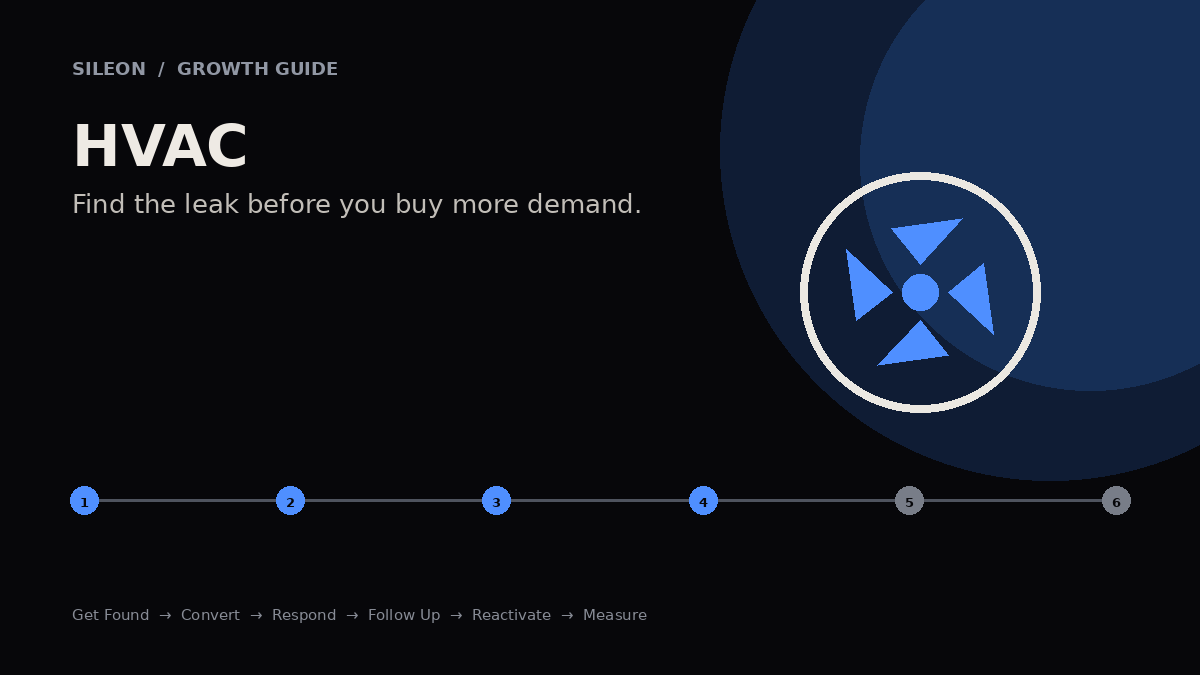
HVAC customer acquisition growth map showing Get Found, Convert, Respond, Follow Up, Reactivate and Measure.
Sileon’s six-station customer-acquisition framework applied to HVAC growth.
Quick answers

Start with the constraint, not another tactic.

More HVAC customers do not automatically require more leads. Fix the customer-acquisition leak first.

How do you grow an HVAC business?

Grow an HVAC business by finding the constraint before adding more demand. If homeowners cannot find you, fix visibility. If they find you but do not call, fix trust and conversion. If inquiries arrive but disappear, fix response and follow-up. Then use retention and measurement to compound what already works.

How do you get more HVAC customers?

Start with the part of the customer path that is actually weak: local visibility, the website, call handling, replacement-estimate follow-up, maintenance reactivation, or source tracking. Buying more leads before fixing downstream leaks can simply make the waste larger.

What should an HVAC company fix before buying more leads?

Confirm that calls and forms are easy to make, someone owns the response, open estimates have a follow-up rule, and you can identify which channels produce legitimate opportunities. More traffic is valuable only when the existing path can convert it.

How do you scale HVAC marketing without wasting money?

Increase demand only after you know your capacity and have a repeatable path from search to booked work. Use your own gross-profit math to decide what an additional booked job is worth and which acquisition improvement can reasonably pay for itself.

The short answer

Grow by fixing the weakest part of the customer path before adding more demand.

Start here

Which part of the HVAC growth system is actually holding you back?

A bigger marketing budget only helps if the rest of the path can hold the demand. Use these symptoms to decide where to look first.

01
Get Found

The right homeowners are not discovering you often enough for the services and areas you actually want.

Check get found →
02
Convert

People find the company, but too few turn into calls, forms or booked conversations.

Check convert →
03
Respond

Calls, forms or messages arrive, but the first response depends on whoever happens to be free.

Check respond →
04
Follow Up

Replacement quotes, maintenance opportunities or open leads go quiet after the first conversation.

Check follow up →
05
Reactivate

Years of customers and old estimates sit in the database while growth starts from zero every month.

Check reactivate →
06
Measure

You spend on marketing but cannot clearly tie real inquiries and booked work back to the source.

Check measure →

1. Get found for the HVAC work you actually want.

“More leads” is too vague. A residential HVAC company may want emergency no-cool calls in July, replacement opportunities, heat-pump work, maintenance-plan customers or a stronger presence in a few specific towns. Those are different acquisition problems.

Start by deciding which services and service areas matter economically. Then make sure your Google Business Profile, website and other public signals describe the real business clearly. Your primary category, service information, hours, phone number, service area, photos and reviews should help a homeowner understand what you do without detective work.

What to inspect

  • Keep the Google Business Profile complete, accurate and active.
  • Give priority HVAC services enough page depth to stand on their own.
  • Create local pages only when there is real local information and service relevance to support them.
  • Build a consistent review-request habit after real customer experiences.
  • Measure qualified inquiries and booked opportunities instead of obsessing over one vanity ranking.
Sileon fit: If the leak is discovery, Search Growth is the relevant service. For deeper self-checks, see Google Maps visibility and review generation.

2. Turn more of the attention you already earned into calls.

HVAC buyers often compare several companies quickly. The site has to make the basics obvious: what you service, where you work, whether the company looks trustworthy, and what the visitor should do next. A technically good website can still underperform if the offer is vague, proof is buried or mobile contact is awkward.

Replacement work is a different decision from a repair call. Bigger projects may need stronger proof, financing context, equipment or process explanations and a clear path to request an estimate. Emergency intent needs a fast, direct contact path. The website should match the buying situation instead of treating every visitor the same.

What to inspect

  • Read the first screen on a phone as if you have never heard of the company.
  • Check whether priority services have clear, useful pages rather than generic copy.
  • Put real proof near the decisions it supports: reviews, credentials, project photos, warranties or process detail when accurate.
  • Test every call button and form yourself.
  • Separate traffic problems from conversion problems before paying for more clicks.
Sileon fit: If the site is wasting attention, start with the website lead test or Sileon’s website conversion work.

3. Treat the first response like part of marketing.

HVAC demand often arrives when the owner, dispatcher or technician is already busy. That makes response a system problem, not a motivation problem. A good inquiry should not become invisible because a call went to voicemail or a form notification landed in one inbox.

Map what happens after every supported inquiry type. Who sees it? Where is it recorded? What happens after a missed call? What happens after a web form? Who owns the next step? If the answer changes depending on who is working that day, the response layer is fragile.

What to inspect

  • Define where calls, forms and supported messages go.
  • Decide what can be acknowledged automatically and what requires a person.
  • Keep legitimate inquiries visible until someone takes ownership.
  • Fit the workflow around the CRM or field-service platform already in use when practical.
Sileon fit: For businesses already generating inquiries, Customer Engine addresses response and written follow-up. The missed-call guide shows the logic before you buy anything.

4. Stop treating the first estimate as the end of the sales process.

Replacement work and non-emergency HVAC projects can involve comparison shopping, financing questions, household decisions and timing. “They didn’t answer, so I guess they weren’t interested” is not a follow-up system.

Start with the open opportunities that already exist: replacement estimates, maintenance proposals, older inbound leads and people who asked for information but never booked. Decide which opportunities genuinely deserve another touch, what the next message should help with and when the lead should be closed out rather than chased forever.

What to inspect

  • Confirm the estimate or next step was received.
  • Answer a likely decision question instead of sending “just checking in.”
  • Make it easy to ask a question, book or say the timing is not right.
  • Stop when the opportunity is closed or the context no longer supports another message.
Sileon fit: Use the estimate follow-up guide to define the human process first. Customer Engine becomes useful when memory is the bottleneck.

5. Use the customer base you already paid to acquire.

An HVAC company can accumulate years of customers: repairs, installations, tune-ups, older maintenance customers and estimates that never moved forward. That audience already has some relationship with the business. In the right circumstances, reconnecting with them can be more rational than starting every growth push with strangers.

Reactivation should have a legitimate reason. Seasonal maintenance, a relevant service reminder, equipment age, a prior unsold estimate or another real customer need can justify a focused campaign. A generic blast to a stale list is not a strategy.

What to inspect

  • Segment by a real service or timing reason.
  • Use the customer’s existing relationship instead of pretending it is a cold prospect.
  • Respect consent, channel rules and opt-outs.
  • Measure replies and booked work where attribution is available.
Sileon fit: Customer Reactivation is a scoped campaign, not an automatic retainer. Read how to reactivate old customers first.

6. Know what actually produces HVAC opportunities.

Growth gets expensive when the business cannot tell which marketing produces real inquiries. “Google seems busy” or “Facebook gets engagement” does not answer whether the channel generates qualified calls, estimates or booked work.

Measurement does not need to become an executive dashboard. Start with a readable chain: source → inquiry → opportunity → booked work where the systems support it. If a source cannot be measured perfectly, label the limitation instead of pretending attribution is exact.

What to inspect

  • Which sources generated legitimate inquiries?
  • Which sources generated the kinds of HVAC jobs you actually want?
  • Where did those inquiries fall out of the process?
  • What should receive more attention next month, and what should be cut or fixed first?
Sileon fit: Tracking & Attribution is for clearer source visibility. The lead-source tracking guide explains what can and cannot be known.
The economics

Before you buy more marketing, calculate what one recovered HVAC job is worth.

Use your own gross profit and inquiry numbers. This is break-even and scenario math only — not a forecast, benchmark or promise from Sileon.

Run a simple scenario

Use what the business keeps from a typical booked job after direct labor and materials, not the full sale price.

Use a scenario you consider plausible. The calculator does not predict that Sileon will create the improvement.

Hypothetical additional gross profit / month
Enter your numbers

We’ll show the number of additional booked jobs implied by your scenario.

Know the limit

Sometimes customer acquisition is not the thing holding the HVAC business back.

If the real constraint is technician capacity, dispatch, pricing, cash flow, inventory or operational management, more leads can make the business worse. Sileon should not sell around that.

Where Sileon can help

Search visibility, website conversion, inquiry response, written follow-up, customer reactivation and marketing measurement.

Where we are not pretending to be the expert

HVAC technician hiring, field dispatch, job costing, financing, fleet operations, inventory, licensing or trade-specific financial management.

90-day order of operations

Fix the leak before you increase the pressure.

A practical sequence for an established HVAC company that wants more of the right work.

01
Weeks 1–2

Map how customers currently find you, contact you and move from inquiry to booked work. Fix obvious broken contact paths and measurement gaps.

Diagnose first
02
Weeks 2–4

Strengthen the weakest existing station: profile/search visibility, website conversion, response or estimate follow-up.

Repair the leak
03
Month 2

Build repeatability: review requests, service-page depth, response ownership, follow-up rules and clear source tracking.

Create the system
04
Month 3

Only after the path is stronger, decide whether you actually need more demand, broader service-area visibility, paid media or customer reactivation.

Add pressure carefully
Free growth audit

Want me to find the highest-value leak in your HVAC customer path?

Send the business. I’ll review what I can verify across the website and public customer-acquisition path, explain where I would start, and tell you if the math does not justify hiring Sileon.