How do you grow a masonry business?
Build visibility around the masonry services you actually want, show labeled proof of similar work, qualify project fit, follow up on estimates and track which sources become booked projects.
Masonry sells through visible craft, local reputation and project fit. Growth gets harder when stonework, brick repair, chimneys, patios and structural work are all marketed as one generic service—or when good estimates disappear after the site visit.
The page, photos and intake process should help a prospect understand whether you do their kind of masonry work before the estimator invests time.
Build visibility around the masonry services you actually want, show labeled proof of similar work, qualify project fit, follow up on estimates and track which sources become booked projects.
Local search, reviews, referrals and visible project proof can all contribute. The best mix depends on whether the current shortage is discovery, trust or estimate conversion.
Standardize inquiry response, project qualification, estimate follow-up and measurement so sales does not rely entirely on the owner. Crew and craft capacity still have to scale separately.
Show the actual types of work you want more of—brick, stone, retaining walls, chimneys, patios, repointing, etc.—with truthful project context instead of an unlabeled photo gallery.
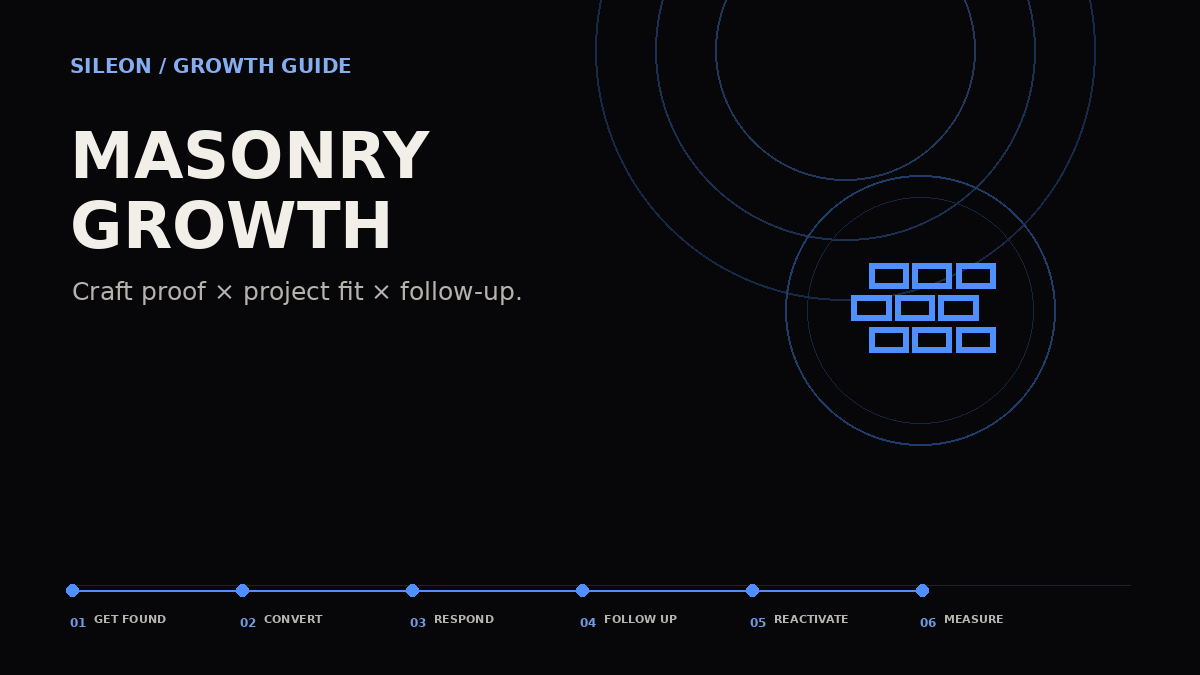
Growth is easier to reason about when the customer journey is broken into observable stages instead of a pile of marketing tactics.
Answer from what you can verify today. “Not sure” is useful: it usually means the measurement layer needs attention before anyone confidently prescribes more marketing.
Can a local prospect with one of your priority masonry needs land on a page that clearly matches the problem?
Can a homeowner see real examples of work like theirs and understand what the company handled?
Does the first response capture location, project type and enough context to decide the next step?
Can you see every viable estimate, whether it is waiting on weather, budget, another trade or a customer decision?
After a successful project, is there a repeatable way to preserve the proof and ask for feedback appropriately?
Can you compare lead sources by the actual brick, stone or repair projects they become?
Answer all six questions to see which station deserves inspection first.
Masonry projects vary in urgency, craft complexity and scope. A six-station view helps separate “not enough demand” from weak project proof or a follow-up leak after the estimate.
Check service-specific visibility for brick, stone, chimneys, walls, patios and repair work that the company truly provides.
Check Get Found →Homeowners may know the symptom—cracked mortar, failing steps, a chimney issue, a patio idea—without knowing the right masonry terminology. The acquisition system should bridge that gap.
Explain the homeowner problem in plain language and connect it to the service without overstating diagnosis from a website.
Wide project shots, details and brief context can make craftsmanship understandable. Label what was actually done.
Weather, permits, adjacent work or budget can delay masonry decisions. Keep viable estimates visible without treating every pause as a loss.
Masonry customers may search by material, structure or symptom. A site that only says “masonry contractor” can miss the language a homeowner actually uses.
The goal is not to create hundreds of thin pages. It is to organize important services so the company is understandable to both prospects and search engines.
Improvement means stronger qualified discovery around the masonry services the business wants to sell.
Craft businesses are easy to under-sell online because the owner sees quality differences that a homeowner may not know how to evaluate.
Good conversion design translates those differences into understandable evidence without inventing awards, years or performance claims.
Improvement means the traffic already arriving has more confidence and more good-fit prospects request an estimate.
Some masonry work can be triaged with basic information or photos before a site visit, while other projects genuinely require inspection. The intake process should support that judgment.
The purpose is not to diagnose structural conditions remotely. It is to route the opportunity intelligently.
Improvement means legitimate inquiries are acknowledged and estimator time is reserved for plausible fits.
Masonry projects can pause for reasons unrelated to interest. A customer may be coordinating roofing, landscaping, excavation or a larger renovation.
A simple status and follow-up process prevents those jobs from disappearing while respecting the customer’s actual timing.
Improvement means viable estimates remain visible until a real decision or deferment is documented.
Masonry work can last for years and remain visible to neighbors. A completed project is one of the strongest future marketing assets when it is documented truthfully.
The customer relationship can also lead to referrals, but that should follow a good experience rather than feel like an automatic sales sequence.
Improvement means the business accumulates more verified local proof and appropriate referrals.
A broad directory lead and an organic stonework inquiry may have very different fit and economics. Without attribution, those differences disappear inside a single “lead count.”
The measurement system does not need to be complicated; it needs to be used consistently.
Improvement means marketing decisions can follow project outcomes rather than impressions alone.
Start with what is observable. If the company is visible and getting estimate requests, the next best move may have nothing to do with increasing traffic.
A diagnosis only matters if it changes what gets done. These are example directions, not a promise that every business needs every service.
Organize visibility around real masonry services and the homeowner language attached to them.
Turn real project proof into clear evidence for the prospect’s specific job.
Keep estimates visible across weather, budget and project dependencies.
Use your own gross-profit and opportunity numbers. This is scenario math, not an industry benchmark, forecast or Sileon promise.
Use the gross profit from the masonry category you actually want to grow. Do not use a generic industry ticket size—the economics of repointing, a patio and structural stonework can be completely different.
Use gross profit rather than revenue if you can. If you do not know the inputs, that is a measurement problem worth fixing first.
This calculator only compares two owner-provided conversion scenarios.
The metric should match the station. Rankings, traffic or automation activity are not enough by themselves if the business cannot connect them to an acquisition outcome.
Track service-level search discovery and qualified estimate requests.
Track qualified estimate requests from service/project pages and proof interactions.
Track response, qualification status and site-visit scheduling.
Track open estimates, deferred reasons, follow-ups and booked projects.
Track new proof assets, reviews, referrals and repeat inquiries from past clients.
Track source → project category → estimate → booked work.
Masonry quality depends on field execution. If the limiting factor is experienced labor, supervision, production scheduling or material availability, adding demand can make the customer experience worse.
The first 90 days should make priority masonry services easier to find, improve how the work is proven, and create a visible estimate pipeline.
Identify priority project categories, existing search visibility, strongest proof, response process and open estimates.
Sequence, then measureImprove service discovery, project proof, response or follow-up based on the baseline.
Sequence, then measureTrack which project pages and sources create qualified estimates and booked masonry work before expanding further.
Sequence, then measureThe free growth audit looks at search, project proof, response, estimate follow-up and tracking before recommending more traffic.